Monday, 25 March 2013

8 Kenyan Entrepreneurs Listed in Forbes Top 30 Under 30


The young African entrepreneurs, disruptor and innovators

Eight young Kenyans under the age of 30 years have made it to the elite list of Forbes top 30 under 30. The seven gentlemen and one lady have been feted for their exceptional performance and exemplary service in different industries.

“The young African entrepreneurs, disruptors and innovators featured on this list are impatient to change Africa and together represent the entrepreneurial, innovative and intellectual best of their generation,” said Mr. Mfonobong Nsehe a writer at www.forbes.com.

An outside panel of 12 judges from across Africa was picked to help identify the group of outstanding entrepreneurs and innovators under the age of 30, in November last year according to Nsehe.  In each of 15 categories, ranging from technology, real estate to social entrepreneurs, Forbes editors and reporters together with judges choose the field’s brightest stars who are individually most surprising, engaging, and hard working.

The eight Kenyans include:
Evans Wadongo
Chairman, SDFA Kenya
“Wadongo, a 26 year-old Kenyan engineer designed a solar-powered LED lantern called MwangaBora (Swahili for “Good Light”), an invention which is fast replacing smoky kerosene lamps and firelight in rural Kenya. Wadongo has been distributing thousands of these lanterns throughout rural Kenya where there is little or no electricity. His organization, Sustainable Development For All (SDFA) sponsors an empowerment initiative that teaches poor Kenyans how to reproduce these solar lanterns and sell for profit.” Forbes
.
Cosmas Ochieng, Founder, Ecofuels Kenya
Cosmas Ochieng, a 26 year-old Kenyan entrepreneur runs Ecofuels Kenya, an East Africa firm which produces environmentally friendly, green biofuels and organic fertilizers from renewable indigenous sources such as the croton nut.
Two Kenyan youths in the real estate sector have been named among the top 30 African entrepreneurs under the age of 30 who are making the most dramatic impact across Africa in the prestigious Forbes annual listing of the 30 under 30 innovators and entrepreneurs.

Erick Muthomi, Founder, Stawi Foods & Fruits
The 26 year-old Kenyan entrepreneur is the founder of Stawi Foods and Fruits, an innovative start-up which procures bananas from smallholder farmers in rural Kenya and processes them into banana flour.

Joel Mwale, Founder, Skydrop Enterprises
Mwale Joel
Mwale, Founder Skydrop Enterprises
Mwale who is 20 years old runs SkyDrop Enterprises, a rainwater filtration and bottling company which produces low-cost purified drinking water, milk and other dairy products in Kenya. Mwale founded Skydrop in December 2009 and the company now employs over 20 people.
.
Lorna Rutto, Founder, EcoPost
Lorna, Ecopost
Lorna, Ecopost
Lorna Rutto, 28 is the founder of EcoPost, a profitable social enterprise which manufactures aesthetic, durable and environmentally friendly fencing posts using plastic waste, a more environmentally friendly alternative to timber. EcoPost collects this plastic waste (such as polypropylene and polyethylene) and manufactures fencing posts from it. Rutto has earned international acclaim for her efforts in providing an alternative waste management solution to Kenya’s plastic menace.
.
Mark Kaigwa, Partner, Afrinnovator
Mark
Mark Kaigwa, Partner Afrinnovator
Mark Kaigwa, 25 is a multi-talented creative director, filmmaker, digital marketer and entrepreneur. Kaigwa is a co-founder and partner at Afrinnovator, a venture which aims to put Africa on the map by publishing exploits across African innovation, technology and start-ups. He is also Partner at African Digital Art – the web’s leading resource for creative inspiration in animation, illustration, photography and design from Africa – Forbes

Ian Kahara and Kimiti Wanjara, Founders, Serene Housing developers
The two, both 29, made headlines as a breed of young vanguard entrepreneurs who beat all financial odds to bet their fortunes on the lucrative real estate sector, creating a 350 million development, Sigona Valley, an exclusive gated community in West Nairobi.

“The listing came as a complete surprise to us, when we started we had a dream of getting into real estate we never realised the impact it would have on young people also interested in getting into the industry in Kenya,” said Ian Kahara Director, Serene Valley Properties Limited, the developer of Sigona Valley.
“Being listed in the 30 under 30 innovators and entrepreneurs is a humbling experience that reinforces the need for perseverance, dedication, a clear goal, divine intervention and is a challenge to do more,” said an elated Mr. Kimiti Wanjaria, Director, Serene Valley Properties Limited.
Some of those who have featured in the Forbes list include Kenya’s business magnate Chris Kirubi, Uhuru Kenyatta and Sameer Group proprietor Naushad Merali in the top 40 wealthiest Africans list.
Kimiti and Ian both ICT graduates together with 28-year-old quantity surveyor Thomas Koigi, and 37-year-old biochemist Johnson Waweru, proprietors of Serene Valley Properties Limited launched Sigona Valley in March 2012, having raised secure non-bank, development finance from Shelter Afrique to fund their project.

Friday, 22 March 2013

Kenyan Born UK Entrepreneur Julius Kamau achieves a worthwhile Property Investment. A Childhood Dream into KSh2 billion Rainbow Resort.

The newly opened Rainbow Resort along the Nairobi-Thika super highway.
Website: http://rainbowruiruresort.com/#!/
Facebook: https://www.facebook.com/RainbowRuiruResort
Publisher: www.businessdailyafrica ©All Rights Reserved.
Photo/Salaton Njau ©All Rights Reserved.
By SIMON CIURI
Posted  Thursday, March 21  2013 at  21:25
In 1982, Julius Kamau, then a college student, dreamt of standing on top of his own beautiful hotel with water fountains and flowers sipping coffee. For the young man from a poor family, the prospects of realising that dream then appeared remote.
‘‘I then laughed at myself... I was as broke as a desert rat,” Mr Kamau says.
Thirty one years later, his daughter Pauline Kamau sits at the Rainbow Ruiru Resort’s reception attending to a client— a hotel that her father has built.
Mr Kamau started the journey to fulfil his childhood dream in 1998 while living in East London. While shopping for vegetables in the foreign land he recalled the dream. He took the first step.
“In January 1998, I asked a Nigerian friend to put this dream into a real picture. He did it and I hanged the picture on the wall. Every morning, I would look at it and say, ‘thank you Lord for giving me a wonderful five-star hotel,’’ he says.
In May the same year, he took the next step. He mortgaged his house and asked his brother to look for one acre piece of land in Ruiru. His brother got him a piece of land but he was disappointed as the land was an abandoned quarry that Ruiru Town Council had earmarked as a dumping site. Little did he know that it is at this quarry where his dream was to be turned into reality.
Today, he has the Rainbow Ruiru Resort in Kiambu County to show for his hardwork, managing to set up an investment in a remote area; a resort many of his friends thought was a waste of money and time because of its location.
It is the serenity and the ambience that draws visitors to the over Sh2 billion resort. Its interior design resembles a royal yacht. The hotel that took Mr Kamau 15 years to build has a helipad, 130 rooms, 12 fully furnished apartments with Internet, a pent house, a cocktail bar, jacuzzi, gym and a business centre.
It has a 300 bed capacity. Accommodation charges range from Sh4,400 to Sh9,900 per night. At the hotel’s 11 floor which houses the helipad, one can see Kilima Mbogo at a distance and the illusion of the mountain moves closer as one watches it from the rooftop.
Constructing the resort was not an easy task. Mr Kamau who runs a security firm, Rainbow Guarding in the UK says the Ruiru investment was funded by savings.
Rainbow Guarding was founded in 1994 and offers security solutions to Berkley Homes, Laing Partnership Housing, Salvation Army and London Property Plc among other companies in UK.
‘‘The owner believes his entire life could not be confined in London,’’ said Mathias Mukundi, the general manager of Rainbow Ruiru Resort.
Ms Kamau has been taking care of her father’s investment; a project she says is a well calculated decision of how Kenyans are sending some of their earnings back home instead of investing all their money in a foreign country.
Mr Kamau came from a humble background and the desire to rise from poverty inspired him to seek a different life. Now 59, he can stand among Kenya’s millionaires, but according to his workers, a humble millionaire.
‘‘The founder is one of those people who despite having immense wealth, he does not use his position to gain prominence, he does not believe in fame but on humane values that can give birth to development-oriented ideas,’’ said Mr Mukundi.

Mr Kamau who still lives in the UK connects tourists visiting Kenya to his hotel. The hotel management also works with local tourism agents to market Rainbow Ruiru Resort. The team is working on ways to make own bookings directly in coming years.
‘‘We want to create a clear contact where tourists visiting Kenya will be flown from the Kenyan airport by our own choppers direct to our hotel, landing at our modern helipad,’’ said Mr Mukundi.
Mr Kamau has entrusted Mr Mukundi who has been in the hospitality industry for 25 years, having worked with major hotel chains in Kenya among them the Sarova Hotels to run his hotel.
Though not a hotelier, Mr Kamau has built the hotel to take advantage of an increasing number of tourists and business travellers coming to Kenya and local visitors seeking adventure in places out of town.
‘‘For years there has never been a hotel in Kiambu County that could accommodate large number of clients and offer services that we are offering now,’’ Mr Mukundi says.
‘‘We are optimistic that this investment will successfully run for decades, we are ready to add values that blend with my father’s aspirations when he was setting up this hotel,’’ said Ms Kamau, who also acts as the hotel’s deputy manager.
East African Breweries is one of their main clients and Mr Mukundi is optimistic that with the new devolved system of government, Rainbow Ruiru Resort’s conference facilities will lure more visitors.
‘‘Thika Superhighway has come as a blessing, with the hotel being a few meters from the main road, the demand for decent yet affordable accommodation is inevitable. We are doing well compared to previous years when Thika road was rough,’’ he said.
Mr Mukundi said there Kenyans in the diaspora should be encouraged to invest back home. He said it is worrying that only a small number of Kenyans are remitting their earnings and investing here.
sciuri@ke.nationmedia.com

Tuesday, 26 February 2013

Property and Home Living Expo 2013

Author: Property and Home Living Expo. ©All Rights Reserved

Nairobi’s biggest Property exhibition, Property and Home living Expo, scheduled for February 21st -24th, 2013 at the Sarit Centre Exhibition Hall. The exhibition, whose theme is “Real Estate as an Investment opportunity in 2013 and beyond seek to promote and popularize Property investments in Kenya.
Property and Home living Expo continues to attract droves of visitors as the future brightens for investors in property as the quest for decent homes among the working middle class intensifies.
Several firms have signed up for participation, as the expo which will feature displays and discussions on both Residential and Commercial property investments with experts in the various fields. In Kenya, Knight Frank employs over 90 office staff and provides services in the commercial, retail and residential markets in Nairobi and Mombasa. Ben Woodhams, Managing Director, together with Maina Mwangi, Executive Director, are responsible for co-ordinating the services lines of property management, agency, valuation, project management, feasibility and research led consultancy. http://www.knightfrank.co.ke
Participating as an exhibitor at The Property and Home living Expo, 2013 will enable you to visually promote your investment or development opportunities and services to the wealthiest and most liquid group of investors who are regular at the venue always checking what’s new in the market.
This year’s expo featured between 5,000 and 6,000 VISITORS and the organisers, Primedia Ltd, are optimistic that next year’s event will register a 10-20 per cent increase in attendance.
Property and Home living Expo 2013 has partnered with several media houses to promote the 2013 Expo which includes Standard News Papers, Asian Weekly Focus on Property Magazine, KTN TV, Capital Fm Radio and East FM Radio.
Roadside banners, foot stickers at the venue, Good Discount via incentives like branded pens, hand bags, Caps, T-shirts during the Expo are part of extra marketing campaign to target the additional 10-20% visitor’s increase.
Property and Home living Expo in its 11th year is all geared up to become a national and regional platform for property development and blessed by the Ministry of Housing since its inception.
Kenyans are moving towards property ownership due to the need self achievement and satisfaction that comes with being in charge of your own little corner of the world.
The pride of home ownership is the greatest benefit of all when it comes to owning a home and the feeling of accomplishment, safety and security that result from home ownership cannot be matched by any other purchase or investment. The event provides a rare opportunity for aspiring home owners to invest today for a better tomorrow when viewing in person the best products available in the market and consult experts in finance, housing industry, all under roof.
“This year’s EXPO, more than any year before will be working to highlight the very best investment options in the market, covering almost all of the nation’s major new housing developments in low, medium and high cost housing and offices,” he said.
The EXPO last year drew over 12,000 visitors reflecting the growing high-level interest in the country’s property market, and as a first hand option of viewing numerous ongoing and new projects announced.

The Exhibitor will come from prominent players in building and construction, mortgage and valuation, property facilities, Financiers, Landscaping, agency project management, Paint companies, Insurance, etc.
Contact: Organised by: Primedia Ltd, Contact Person: Herman Shadeya,

Friday, 22 February 2013

Motivation. They get knowledge not for the sake of knowledge but for the sake of applying it; like the famous Nike slogan says, Just Do it


Just do it

 Author @ Dr Wale Akinyemi wale@powertalks.biz twitter@waleakinyemi


  • 141
     
Last week I learnt something very powerful at a team building event. It was structured in such a way that the different teams had vans and they had to drive over a 28,000 acre reserve in search of clues that would lead them to the next step. It was rigorous and extremely challenging. One of the instructions read that the teams should proceed to a particular location via another one. Each team was expected to bring all the instructions that they got along the way to the judges at the end of the contest. At the end of the event the team that came first was very excited about their win. However, their success was short lived. When the second team came they presented all their instruction leaflets. There were fifteen posts and they had fifteen leaflets. The team that came in first however could produce only thirteen leaflets. It turned out that they had missed two posts by not reading the instruction well and going via the designated location. As a result, even though they celebrated the fact that they came in first. It could not be sustained. There was something little in the past that came to destroy their joy.
Many people experience this in real life. They get to a point where they should be celebrating but their celebration is short lived because of some seemingly simple or insignificant thing that they did or left undone in the past. Their celebration is cut off because of wrong implementation of information.
We must remember that the seeds of tomorrow’s relevance or irrelevance are planted by our actions or inaction today. What is the point in capturing the present and missing the future? What is there to look forward to if our future is merely an extension of our present?
When I was younger and in school I was fascinated by the world of science. I noticed that there was what was called pure science and there was another called applied science. There was pure mathematics and applied mathematics. We can draw powerful lessons from these.
We live in the information age where there is so much information going around. Some people however are living with what I call pure knowledge. When you talk to them they always have answers. They can finish your sentences. They know the latest innovations and they know who is doing what in every area. They talk as if they were eye witnesses to the conversations between leaders. The big challenge however is that when you look at their lives, there is nothing inspiring. Yes they may excite you with the knowledge that they have but that is where it stops. These people are quick to answer but they left something vital along the way. They left the correct application of knowledge behind.
On the other hand there might be someone who does not have as much knowledge but the little that they have they have applied to something and the effect is very visible in their lives. They are not scared to say that they do not know. They get knowledge not for the sake of knowledge but for the sake of applying it. They get knowledge with solutions in mind.
I am an ardent supporter of people getting knowledge but the big question I want to ask today is, does your life reflect the knowledge you already have? If not what could be missing? Could it be that you did not get knowledge with the view of applying it? Application can be difficult. It is only those who dare to apply that aim higher. It is only those who aim higher that ever make mistakes. It is only those who make mistakes that are criticized. It is only those who can handle being criticized that eventually get celebrated.
There is a champion in you waiting to come out. Do a knowledge application table for yourself where you identify the things you learn and the ways in which you have applied the knowledge. You may be very surprised at how below potential you are operating.
Can you for one minute imagine a land where everyone is operating at full potential? You will not need to imagine for long if you start where you are. Match your knowledge with application and make sure you have left nothing behind. This guarantees that you are on your way to real sustainable winning. Many people get to the end of their lives and realize what they could have done. This is the time to apply what you know. Remember, this life that you are living today is not a rehearsal. It’s the real thing so like the famous Nike slogan says, Just Do it!
wale@powertalks.biz twitter@waleakinyemi

Saturday, 16 February 2013

Strategies: Great Business Meetings Surprises!!

Top 6 tips to screw business meetings as usual

Richard Branson
Richard Branson  © All Rights Reserved.


Meetings are an important part of any business, but they are not always the best use of everybody’s time and effort. I have never worked out of a traditional office, and always try to find ways to freshen meetings up. Recently we held Necker Meets Oxford, a Virgin Unite leadership gathering that took a different approach to talking about business. Here are five tips for screwing business meetings as usual:

1. Step away from the usual weekly agenda and set an inspiring theme.
At Necker Meets Oxford, the theme was Solutions for the Future of People and Planet – a bit different from a usual Monday morning! Our aim was to generate discussion to find innovative, entrepreneurial solutions to the world's toughest challenges.

2. Bring together a diverse mix people to broaden discussion.
Convening what might seem an unlikely bunch can really get the ideas flowing. For instance, at our recent gathering we had an investment banker, yoga practitioner, Silicon Valley consultant and the co-founder Wahoo's Fish Taco to name a few. I always find that these eclectic groups lead to great discussions.


3. Engage thought-provoking speakers to spark ideas and generate debate.
We were lucky enough to partner with a great organisation, the Oxford Martin School, for Necker Meets Oxford, bringing together an amazing line up of speakers: Ian Goldin, who heads the Oxford Martin School, Oxford scholar Charles Godfray, Astronomer Chris Lintott (the new face of the BBC series The Sky at Night), Sonia Trigueros of the Oxford Nanotechnology Programme and Kathy Wills, who chairs the Biodiversity Institute at Oxford. From the challenge of feeding a planet of 10 billion people to the wonders of nanotechnology and the advances in medicine, the variety of speakers really got the group and me thinking in new, exploratory ways.

4. A great destination – lose the laptops and say bye to the tie.
A change of scenery and a bit of fun does wonders for getting people thinking differently and loosening up! I’m very fortunate to have the opportunity to invite people to Necker Island – we sometimes take things to the pool… But wherever you are, be innovative with your space. Try a stand-up meeting, or leave the desks and head to the park. Get out of your everyday environment.


5. Surprise the group with something special.
At Necker Meets Oxford we surprised guests with acclaimed singer songwriter Morley, who wowed guests with her unique blend of jazz, folk and soul. A real treat and something out of the ordinary to reflect what was a great meeting of minds. A little thinking outside the box goes a long way in my view.
6. Ban slide presentations!
In my opinion Powerpoint slides with long lists of what you’re talking about should be banned. They are used as a prop by the speaker - if they need reminding of what they’re speaking about they can have it on a laptop in front of them. There a few thing worse than watching someone talk through a long list of Powerpoint’s. On the other hand short videos and photos bring a talk to life.

Find out more about the next Virgin Unite gathering.
Image(s) by Jack Brockway

Monday, 11 February 2013

Twitter Usage In Africa


New research: How Africans are using Twitter


This is a cross-post appearing also at http://www.howwemadeitinafrica.com/ 
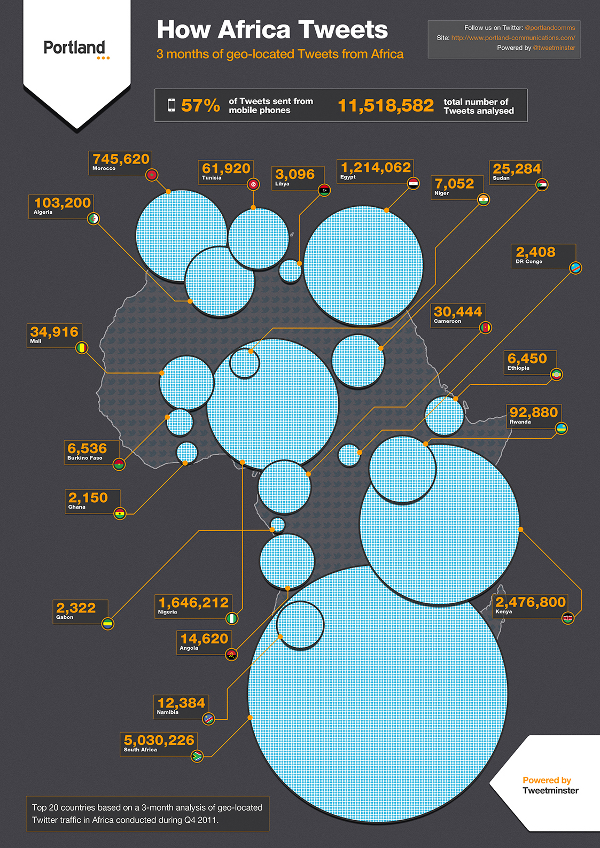
Micro-blogging platform Twitter is growing in popularity on the African continent, with users from South Africa, Kenya, Nigeria, Egypt and Morocco leading the pack.
Communications company Portland, in association with Tweetminster, recently released a map of Twitter use in Africa. To produce the map, over 11.5 million Tweets hailing from the continent were analysed. Five-hundred of Africa’s most enthusiastic Twitter users were also surveyed.
It was found that South Africa is the most active African country on Twitter. Total tweets from South Africa were over 5 million in the last three months of 2011. This is more than double the number of tweets from Kenya (2,476,800) during the same period. Nigeria (1,646,212), Egypt (1,214,062) and Morocco (745,620) made up the remainder of the top five most active countries.
It is interesting to note that the number of tweets from the five countries, don’t correspond to the total internet users in each of the territories. For example, Nigeria has far more internet users than South Africa, but South Africans are much more active on Twitter.
Internet users 30 June 2011Source: Internet World Stats
Country Internet users
Nigeria 43,982,200
Egypt 20,136,000
Morocco 13,213,000
South Africa 6,800,000
Kenya 3,995,500
Portland’s research found that 57% of tweets originating from Africa are sent from mobile phones. The research also shows that 60% of the continent’s most active Twitter users are aged 21 to 29.
Twitter in Africa is mainly used to communicate with friends, with 81% of respondents saying they use the service for social conversation. However, 68% also use Twitter to keep up to date with the news.
Unlike in developed countries, many of Africa’s more public figures are not very active on Twitter. “With some notable exceptions, we found that business and political leaders were largely absent from the debates playing out on Twitter across the continent. As Twitter lifts off in Africa, governments, businesses and development agencies can really no longer afford to stay out of a new space where dialogue will increasingly be taking place,” said Mark Flanagan, Portland’s partner for digital communications.

Moving to Silicon Valley: It is not about the Building, it is about the Culture.

Why Africa’s tech entrepreneurs should think about moving to Silicon Valley


The Savannah Fund is a seed capital fund founded by African and Silicon Valley entrepreneurs that specialises in investments in sub-Saharan African technology startups, with an initial focus on east Africa. Mbwana Alliy, founder and managing partner at the Savannah Fund, shares with Dinfin Mulupi his plans for the fund, as well as his thoughts on the state of technology in the region and why Africa’s entrepreneurs should think of relocating their businesses to Silicon Valley.
Mbwana Alliy
You visited Kenya in December 2010 together with Silicon Valley entrepreneurs Russel Simmons and Paul Bragiel. How did that go?
We wanted to understand the startup scene. That was the purpose of the first meeting. [Consumer review website] Yelp co-founder Russel Simmons mentored some entrepreneurs here. From that meeting we have been working on a couple of things. Paul Bragiel, Erik Hersman (co-founder of Ushahidi) and I have started a seed capital fund, Savannah Fund. We are looking to invest in mobile and web startups. We intend to invest in about 35 startups over time. As part of the accelerator programme we will give seed funding to classes of five early stage, high-growth startups of about $25,000. They will then have three to six months to prove themselves.
The second part of the fund will be a follow on investment to some of the companies of between $100,000 to $200,000. We expect many to fail. When you angel invest you are going to have failures. Out of failure comes good learning. We want to help build the technology scene, but a lot of entrepreneurs don’t understand how things work. I have seen failures in Silicon Valley all the time. Sometimes you fund an entrepreneur who has failed twice and they succeed a third time because they have learnt a lot. We expect maybe even half of the 35 companies we hope to fund will fail. As we continue to invest in the successful ones, the risk will become less and less. One thing we need to change in east Africa is that there is no shame in failure.
You have been active in Silicon Valley, but you are originally from Tanzania. What do you think about the technology scene in Tanzania?
It is improving. I spent a lot of time in the last two to three weeks there. Before I did not like the technology scene there because it was very much government controlled. Now I see the private sector being involved and creating hubs. This is what is needed to grow the sector.
What about the greater east African region?
A lot of the money here goes to less risky investments like real estate. There is not a lot of early stage investment and that is why we started Savannah Fund. For the east African ecosystem to improve we need a lot of angel investors.
What advice would you give to African tech entrepreneurs?
Entrepreneurs are not focused enough. They are doing multiple things. But I understand why. However, when it comes to seeking financing, you have to be committed to your idea 100%. All over east Africa there are too many startups, scattered and unfocused.
I noticed a conversation on Twitter where you talked about talented entrepreneurs moving to Silicon Valley until their home markets get big enough. Please expand on this.
Silicon Valley can be your super highway to get a lot of things done, like funding and access to better talent. There is no question that the best talent in the world is in Silicon Valley. They have all moved there. I moved there, but now I am back.
If a startup is doing well here, they should consider moving to Silicon Valley and compete there in the global market. But at the same time someone can succeed here. But they need to move at some point. Even [Mark] Zuckerberg had to leave Harvard to go to Silicon Valley. You have to go where you are appreciated. East Africa has its own ecosystem and entrepreneurs can succeed in their home markets, but, if you want to build a really big, truly global company, you have to consider other areas and Silicon Valley is definitely top on the list. If I do find a really amazing company, I can help it reach the big league.
However, one should also be cautious. Imagine if you have a company that is doing well in Kenya, but average in Silicon Valley and you expose it too early; it might hurt it. You don’t want to expose it too early, but you also don’t want to never expose it. Question is: when is the right time?
What do you think of Kenya’s ambitious Konza City project (a planned high-tech hub inspired by Silicon Valley)?
I think it is just a real estate project, it is not innovation. Don’t confuse Konza City with creating entrepreneurs and innovation. It is an interesting project. A lot of people see it as the crown jewel of what technology in Kenya is. I don’t think that’s the case. We should be investing in entrepreneurs, developers and more technology hubs. The hub could be in the middle of a slum, but you could still find the next Zuckerberg. It is not about the building, it is about the culture and the things I have talked about like failure, learning and taking risks. I am grateful though that Kenya is attracting foreign investors as well as technology entrepreneurs from across the world.

Sunday, 10 February 2013

Social Culture: Patriotism Goes beyond Social Media


Author Vimal Shah @All Rights Reserved
Dear voters,
Do you know just how crucial your vote is to the future of this country? Why are some of you so indifferent to politics? Why is it that rather than get directly involved in politics you choose to take to social media to air your views?
Your apparent apathy to Kenya’s politics worries me. While I do agree with you that a lack of true leaders amongst many of our politicians is the reason this country is not as economically developed or as ethnically tolerant as it should be, your lack of interest in politics is also partly to blame for this leadership void.
Taking to Twitter and Facebook to ridicule politicians and whine about the loss of the ‘better candidate’ in the recently held party primaries cannot be defined as active involvement in politics or the running of the country; going out to vote can. As much as discussing so-and-so who shouts the loudest in and outside Parliament but has little to show for bettering his/her constituents shows that you have an idea of what is going on in the political arena, statements such as ‘I could not go out and vote because I didn’t have time’ show that you do not care for your country as much as you would like people to believe.
It is a shame that many in the middle class have taken a back seat when it comes to politics. You need to understand that your vote counts just as much as that of the politician and the low income earner, and that no election is too trivial for you. But you seem not to know this, which is why politicians always by-pass you in favour of the masses who are willing to cast their votes for those whose policies they know nothing about.
If you think I’m wrong, tell me: do politicians hold rallies in Kileleshwa or Karen? Why do they always retreat to the low income settlements if their inhabitants do not matter? They do this because they know you will not vote anyway!
A report released by the African Development Bank (AfDB) in January 2012 estimated the number of Kenya’s middle class at 17 percent of the population. Although this means that the middle class is by far out-numbered by low income earners (the World Bank estimates that 44 to 46 percent of Kenyans live below the poverty line), it also means that this class makes up a sizeable chunk of eligible voters.
The middle class can influence the direction this country takes just by being a little more interested in the political affairs of this country. It is not just about talking to your gated-community neighbours about how poorly run this country is; it is about positively influencing everybody you come into contact with, including the domestic workers and others you rely on to keep your home/office/business running.
Every day in our papers we read that Kenya’s middle class is growing, backed by figures that show, for example, that the number of personal vehicles on our roads doubled between 2002 and 2007. If that is true, then the influence of the middle class should also be growing. If the middle class contributes so much to this economy, shouldn’t this same class actively participate in the running of the same economy it helps fuel?
You cannot afford to scoff at the masses that attend mid-week rallies held by politicians, logging onto your social media profile to call these Kenyans ‘idle’ and point out that these Kenyans are there because they are jobless yet politicians do not care. Remember that these ‘idle’ Kenyans are the same ones incited to violence so they can earn a few shillings. Remember that these same Kenyans are willing to fight for what they believe in, be it right or wrong. Many of them are very smart young people who have not had any economic opportunity to partake in development.
Your indifference to politics is not a sign of your superiority over the ‘easily misguided’ masses. By hiding behind social media instead of queuing to vote, you are saying that you do not care about Kenya. By refusing to use your power to vote you are relinquishing any right to comment on the affairs of this country, be they social, economic or political.
As we head towards the March 4th 2013 general election you need to demonstrate that your patriotism is more than wearing a ‘Proud to be Kenyan’ T-shirt bought at your local mall. You need to show that you understand the Mkenya Daima campaign encouraging Kenyans to be ‘wenye nchi’ and not just ‘wana nchi.’
You have shown that you can use social media to make a difference, as evidenced by Twitter campaigns such as #Kenyans4Kenya. It is now time to get off social media and take action: be one of the voters who will queue to vote on March 4th. It is time to take the future of this country into your hands, and not only on your keyboard.
Our country needs you. Vote for integrity and vote for the people who you think will bring the change and the future that you desire – but please DO GO OUT AND VOTE!

(The writer is the vice chairman of KEPSA and chairman of the MKenya Daima steering committee)

Thursday, 7 February 2013

Theme: Confidence Factor

Coffee with Dr Wale

On Thursday 7th February 2013, 6pm -8pm, KICC, Lenana Hall.

Motivation Culture -Theme: Confidence Culture. Confidence is not a gift. It is a fruit of the human spirit that can be cultivated by anyone. PowerTalks http://www.powertalks.biz/coffee-with-dr-wale/ with Wale Akinyemi http://www.waleakinyemi.com/


The Confidence Factor
One common trait that winners have that separates them from the rest of the pack is confidence. It is the attribute that makes people step out even when it does not look like a popular thing to do. It is what makes a person lift their head high regardless. It is what aids swift decision making. It is what differentiates those who propound theories and those who execute. Many live with a misconception that confidence is a gift that was given to some special people and so we say things like – that man is very confident. Confidence is not a gift. It is a fruit of the human spirit that can be cultivated by anyone. This session will transform your thinking completely and translate you to a person of action. Think of the number of ideas that you have had that are just lying down somewhere. It’s time to do something about them. Make this a truly new year in your life and not just the extension of an old year. Come and equip yourself with the confidence boost to take you from where you are to where you want to be.

Wednesday, 6 February 2013

The Silicon Savannah Hype or Reality Discussion at the iHub

Mobile in East Africa. Is Reality Finally Getting Through?

Last week, an illustrious panel was joined by a reasonably sized audience at the iHub in Nairobi for a no-holds-barred discussion on the question is the Silicon Savannah hype or reality? Andrea Bonstedt triggered the discussion earlier in the week with an article published in The Star that resulted in animated discussions online. Sitting on the panel with Conrad Akunga and Njeri Rionge, she clarified her position on “Not every techie is an entrepreneur”. There’s a good summary of the evenings discussions on the iHub blog and in this follow-up piece by Andrea.
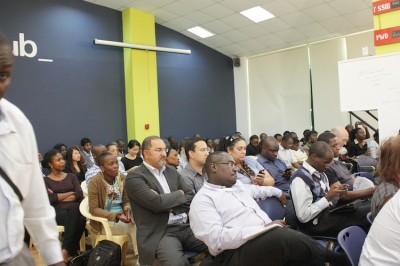
An event in session at the iHub.
General consensus by the panel was that there’s still a long way to go and more to be done to improve the start-up ecosystem in Kenya. In conversations with a few private equity fund managers over the last week, Andrea’s claims were supported; there is still very little potential within the sector for fund managers to grow their pipelines from tech startups.
Meanwhile, inMobi announced it was scaling down its international operations and closing down offices in Africa and Russia. These markets will now be served by their London office. This at a time when the numbers show mobile penetration as rising exponentially on the continent. In the face of declining ARPU there’s increasing demand for data across Africa and the globe but the growth of smartphones on the continent is still slow. One plus one should equal two. Rising mobile penetration plus increasing demand for data should mean (somewhere in there) that there’s huge potential in the short term for businesses providing content and services on mobile via the internet. In my opinion, the potential is probably bigger than any commentator can say. It’s my view that the problem is in the timing. Apparently, users on the continent are on their own clock and exhibiting online behavior that deviates sufficiently from the norm common in the west as to make it less attractive for businesses like inMobi to justify a physical presence here.
Within this hype-vs-reality quandary lies a question which, due to inadequate answers, is probably one of the biggest reasons tech startups on the continent struggle. What do users in the mass market do with their mobile phones and how do they do it? A study by iHub Research funded by infoDev takes a stab at this problem from a high level perspective providing entrepreneurs planning to launch products/services designed for the mass market with useful analysis.
Hype gives us all something to aspire to. Reality makes sure only products that score well on the utility vs hype ratio stay alive. It’s natural selection at its best. Until we find actionable insights on user behavior related to mobile telephony on the continent we may have little to show but hype. Without actionable insights only chance can produce apps/services people would pay for.
But what can be done to give tech startups in sub Sahara Africa a fighting chance in this difficult operating environment? I can think of three quick ways.
  1. Less hype more work. I am all for hackathons, pitchfests and all manner of contests that put young entrepreneurs in the lime light. I believe they are an important part of the ecosystem allowing stories to spread and giving young people something to aspire to. Let’s add to these events metrics that reward entrepreneurs who successfully bring to market their products otherwise the only story we tell is about people who build cool things. Let’s also take these events on the road to cities and towns other than Nairobi, Dar es Salaam, Kampala and Kigali.
  2. Teach shipping. We should find ways of teaching basic entrepreneurship in our institutions so that we help young business owners understand how to build teams and run businesses. That way they know what to look for in someone to run things for them. Most of all, more focus should be put on equipping start-ups with the skills to ship products. It’s pointless building a great app if all it ever does is get whipped out at the next challenge/competition/pitchfest. Get customers or close up shop. Those who end up in formal employment would benefit from these skills as they, by necessity, include focus, project management and strategy.
  3. Think business. What are we building? Who shall use it? How will we get paid for it? How will they obtain it? How will we support them? How much will it cost us to do this? How will we grow to break even? We need to spend less focus on grants and more focus on building sustainable enterprises that make more money than is spent running them. I am always surprised by the number of tech startup owners who can’t answer 5 out of 7 of the questions above.
  4. Learn from people. It is difficult to become an expert in a problem users face until you have met them and spoken to them. Building a solution to a problem implies that one understands it enough to be somewhat of an expert on it. Basic design thinking skills coupled with lean methodologies can provide young businesses with the agility they need  to learn quickly and launch compelling solutions. Putting your product out in the wild and learning from user experiences and feedback is invaluable to a young business. Leave the attitude at home and go out the door where you can learn from other people.
The reality isn’t pretty. The mobile technology industry in East Africa, though still in its infancy, has come along way already. In this hyper-connected age, we just haven’t come far enough fast enough.

Read more: http://semacraft.com/blog/2012/10/mobile-in-east-africa-is-reality-finally-getting-through/#ixzz2K9C4CtP7

Monday, 7 January 2013

Business Culture Case Study, Mitigating Business Multi-cultural interactions

contractors Business culture case study: German vs. Mexican thinking

A project manager and top client can’t get along

I recently had a client come to me with a query about his construction & design firm. As a general contractor operating in multiple cities in the Southwest, he’s seen a lot of interesting client interactions, but this one in particular took the cake.
“My project manager and one of my best clients can’t get along. It’s going to cost me BIG,” he huffed over a lukewarm cup of coffee. He is relying on this client to, as most general contractors do, recommend his service to others in order to grow his book of business. As I asked him to explain key scenarios that have played out, I could see the cultural issues that were bubbling to the surface. While the overarching issue was communication, here are the two big offshoots that emerged from interactions between his Mexican-born project manager and his German-national client.

Issue one: gender roles

Germans, like Americans, have very loosely defined gender roles in modern society. Women wear pants, work in high-level positions, and some men even stay home on “paternity leave.” As such, there is no shock when men and women interact if a woman gives orders or suggestions to men. With a very conservative Mexican man with well-defined gender roles, the aforementioned are foreign concepts to him and would be cause for discomfort.
The project manager wanted to have interaction and take direction solely from the client’s husband. Once it was clear what the issue was, having a group status meeting, which included the husband, brought about a change in the project manager. Once he was able to see that the husband viewed this remodel as the wife’s project, the project manager was then able to see that she wasn’t trying to take over or control her husband, but in essence was driving her vision to fruition.

Issue two: timing

In Germany, time is greatly valued, and punctuality is expected. Conversely, in most of Mexico, there exists a loose concept of time. While schedules can be made, it’s best to deal in the general instead of the specific. Plans are made around the day, not the hour, as is the case in America.
When the project manager explained that the remodeling project would take two weeks to complete, his clients were pleased. The problems arose when the clients misunderstood how the two weeks would play out. Instead of the project manager and team arriving 2-3 days a week, the clients assumed the team of workers would be there literally every day for at least 8 hours a day for two weeks.
As a result, the clients felt as if the team was taking advantage of them, and wasting their time. To reduce the diminishing trust, it was imperative to clear up this misunderstanding. A schedule to the day was outlined, and the clients felt at ease.

Now a success story

All in all, these missteps are surmountable. I’m happy to report that the project manager and client, while not best of friends, are able to work more smoothly together. As the project nears completion, early word-of-mouth recommendations are underway.
It’s important to keep in mind when engaged in multi-cultural interactions that you (the one providing the service) are the subject-matter expert. Remembering that fact, and balancing it with potential cultural differences, you can ensure the success of that relationship, and improve referrals.

Friday, 4 January 2013

Business Culture: Why Companies Should Handle Social Media Like Dating

 Author: Muthuri Kinyamu, Kenyan Marketer
Kenyan Marketer: Why Companies Should Handle Social Media Like Dati...: Five Social Media Tips You Can Learn From Dating I know the title of this post arouses curiosity but am about to prove why you...

  2.      TAKE THE MOVE!
After you have the place to do your search, you now take the bold move to approach the girl, so I assume you have already set up the social media channels, well branded and with profiles nicely filled up with information. As you do with dating, you dress properly (branding), take the girl to a nice restaurant, go to church with her and such! So here’s a few tips to help you with that crucial first date!
·         Be bold – Don’t be afraid to share your thoughts, opinions and ideas with her. On social media don’t be neutral! Be a rebel or the hero. Neutral content/discussion doesn’t arouse engagement! Be very keen as you don’t want the girl to curse meeting you same thing, if your content isn’t great on social media, people will leave!
·         Post less –Sharing everything on your mind or what you come across will push her away so is the community you have on social media! You don’t keep calling her and texting all day so the same works with social media! If you're pushing serious content tweeting and posting in the morning may get you RT's. Sharing content when your community is not online will not earn you engagement.  Use Tweriod  to see when you tweet and when your friends/followers tweet. Then tweet during those times to increase engagement. You also need a content plan and a maintenance schedule for all your social media channels with a policy/guidelines as you don’t want admins to post anything!
·         Use the 1/9 tweet rule –Those who only share their own content are transparent and audiences online look at that as purely selfish and switch off quickly. Get in the habit of sharing 9 tweets not about you or your business for every post about you or your business. This way you don’t spam people; the same thing applies to dating- you don’t talk endlessly about yourself! Do less of push marketing, no “Me, me, me’ kind of content. A good ratio of sharing to promoting your own content on Facebook is 4:1 as a minimum (the more you share about other valuable content i.e. less marketing messages, the more you get in return). Be sure you only share content that adds value to your community – content which they’ll find useful. If it’s a mixed up case scenario share content that benefits people across the board.

Monday, 24 December 2012

Wish You All a Meru Christmas and Successful New Year 2013

Wish You a Meru Christmas with Great Celebrations/Festivals en Successful New Year 2013!!!


Sunday, 25 November 2012

Being Indispensable


Are You Truly Indispensable At Work--Or Just Fooling Yourself?


Committing to make yourself indispensable is one of the most important steps you will take toward being successful and living a fulfilling life. Making yourself indispensable is not about position, power, or ego. It is about taking charge, overcoming obstacles, and achieving your dreams at work, at home, and in your life. Making yourself indispensable is made up of six key spokes: being purpose driven, playing big, being adaptable, being we centered, being priority focused, and valuing others. Ultimately, making yourself indispensable is about committing to a bigger purpose than yourself and making a meaningful difference to your organization, your team, your family, and your community.

Making yourself indispensable is for everyone, regardless of your position, role, or lot in life. Today’s business environment doesn’t allow for satisfaction with the status quo. It requires constant growth and change. Being indispensable means that you are adaptable, learning and growing with your organization as it changes and evolves. You remain valuable to your organization, to your team, and to the important people in your life. If you aren’t changing with your organization, in essence you are becoming obsolete. So at the end of the day, you are either working to make yourself indispensable or working to make yourself obsolete.

Have you ever known someone who acted indispensable when they weren’t? Some do this in the form of loud “notice me” or “bow down to me” behavior or in the form of quietly expecting others to give them everything without having to work for anything. In either case, these people don’t give as much as they take, which is the ultimate demise of true indispensability. They are annoying at best and destructive at worst. Let’s explore the makeup of those faking their way to feeling indispensable so that we make sure to avoid this initial trap on the path to being truly indispensable.

Using power and force to make yourself indispensable is popular with people who have strong egos, financial wealth, or positional power. They make themselves indispensable by keeping others unsafe, generally through threat. If they have an aggressive nature, they will yell at others or even use physical force and fear to make people do what they want. In a beverage manufacturing plant in Canada that hired me to build the management team, one manager would yell at his direct reports so loudly when they made a mistake that it could be heard throughout the plant, causing humiliation and embarrassment for his team. They worked in fear of their manager until they banded together and rebelled. In our personal lives, our spouses and children can feel the same fear when our approach to communication involves emotional or physical mistreatment. The result is hurt feelings, shame, and sometimes abuse.

To act indispensable, some people and organizations use their financial advantage to evoke fear by threatening to take away people’s livelihood--whether a job, a home, or the ability to get a loan. Finally, using positional power is one of the most common means of faking indispensability and is most prevalent in the workplace. Employees witness fake indispensability when managers micromanage, dismiss their ideas, or worse, take credit for the solutions implemented by their team.

The second way people create “fake indispensability” is through entitlement. It arises from overprotective parents who never want their children to feel bad about themselves, an education system that doesn’t push its students to excel or gives everyone a passing grade regardless of their test score, or a group that encourages people to feel entitled by. People with an entitled attitude believe they are indispensable based on their mere existence. As long as they are breathing and taking up space at work, they should be paid--even when they aren’t producing results. And worse, if they ever start breathing hard (even without satisfactory results), they expect a bonus. Thinking we are the best when we are not is the surest and quickest path to dispensability.

No matter how smart you are, how physically strong you are, what religion, race, or creed you come from, what your financial status is, what abilities and talents you possess, or what positional power you have over others, you are not indispensable unless you use your gifts and principles in service to other people’s success, improvement, or survival.

Tuesday, 6 November 2012

Business Leader of The Year 2012, James Mwangi, CEO Kenya's Equity Bank.

EQUITY CEO WINS ALL AFRICA BUSINESS LEADERS AWARDS

Author: Grace Kerongo - Hot Secrets: http://hotsecretz.blogspot.com/

CNBC Africa, the continent’s biggest business news television channel, hosted the second annual ‘All Africa Business Leader Award’s (AABLA) on Thursday 25, October.

Kenya’s Equity Bank CEO, James Mwangi, walked away with the Business Leader of the year prize. It’s the second high profile recognition for the Kenyan businessman, after he won the Ernst & Young World Entrepreneur of the Year in June.

The awards, organised by ABN Productions had took place at the Vodadome in Midrand, South Africa. DStv audiences will be able to see the broadcast of the awards on Tuesday, 30 October 2012 on CNBC Africa at 10pm. The event was hosted by senior CNBC Africa anchor, Alishia Seckam and former ‘Top Billing’ presenter, Nico Panagio. It was attended by captains of industry and government leaders including MEC Nkosiphendule Kolisile, who was the key note speaker.

“I have founded these awards in 2011 as a derivative of the Business Leaders Awards that are held by CNBC all over the world. These awards are a tribute to those Captains of Industry who have made a qualitative difference to the companies, industries and communities that they serve”, said Rakesh Wahi, Founder of the ABN Group.

“On behalf of the ABN Group, I would like to congratulate all the winners and finalists for their superb work, they are promoting African leadership that will eventually create and preserve the wealth and glory that belongs to its people”, he said.

The AABLA 2012 winners in the different categories are:

Business Leader of The Year sponsored by Telkom: James Mwangi, CEO, Equity Bank

Entrepreneur of The Year sponsored by the IDC: Jannie Mouton, CEO, PSG Group

Business Woman of the Year: Funke Opeke, CEO, Main One Cable Company

Young Business Leader of The Year: Jack Kayonga, MD, Rwanda Development Bank

Lifetime Achievement Award: Manu Chandaria , Comcraft

The Forbes Africa Advertising Leader of the Year: Bharat Thakrar, CEO, Scangroup

Forbes Africa Agency Network of the Year:
Ogilvy & Mather Africa

“The AABLAs are an important calendar item in our coverage of African business and markets,’’ said Godfrey Mutizwa, CNBC Africa’s Chief Editor.

“The winners once again demonstrate the quality and depth of business leadership across the continent, and we look forward to continuing to showcase Africa’s best,” he said.

Sunday, 28 October 2012

Kenya Vision 2030 Innovation Award

Kuza Biashara wins Kenya’s Vision 2030 Innovation Award

Author: Wariko (Kuza Biashara)


Kuza Biashara


Sriram Bharatam & Juliet Gateri receiving the Prestigious Vision 2030 Innovation Award 
The Connected Kenya summit came to an exciting end on April 5, as Kuza Biashara emerged top to clinch one of the Nation’s top innovation awards. The Vision 2030 ICT innovation award is part of the Connected Kenya Summit that took place from the April 2-5, 2012. The purpose of these awards, started in 2011, is to “Recognize and Celebrate Kenyans who have developed ICT solutions that drive economic growth and social development as outlined in Kenya’s Vision 2030“.The innovation awards were the creation of the Kenya ICT Board and the Kenya Vision 2030 Delivery Secretariat. All applicants for the awards were required to be registered as a business in Kenya and have had their product in the Kenyan market for at least six months. The applications were then reviewed by a team of independent judges representing the ICT private sector, academia, public sector and civil society. Over 400 applications for different categories from all over the country. Kuza Biashara won the award as the Best Innovation in the Education and Training sector, which was the most hotly contested category. Sriram Bharatam, Founder and Chief Mentor of Kuza Biashara was on hand to accept the award along with Juliet Gateri, Operations Head of Kuza Biashara. Other winners were Green Dreams Tech for their product iCow in the Agriculture sector; Digital Divide Data Kenya, in the Business Process Outsourcing sector; Digital Horizons, in the Financial services sector; Michezo Afrika in the Gender, Youth and Vulnerable groups sector; Social Equity and Poverty Reduction went to ALIN and Compulynx while MamaMikes.com won in the Wholesale and Retail Trade sector.
“Encouraging local innovation is critical for Kenya to achieve Vision 2030. There are a lot of young people who come up with brilliant innovations but it goes to waste if the ideas are not monetized. Vision 2030 hopes to help market and communicate these innovations,” said Mugo Kibati, Director General, Kenya Vision 2030 Delivery Secretariat.
Speaking on this occasion, Sriram Bharatam (Sri) said, “This recognition is a testimony that we are in the right direction and is a great motivator to the 50+ team members of Kuza Biashara across 20 locations in Kenya, to now scale this idea and reach out to transform as many Kenyan small business owners as possible.”

Saturday, 27 October 2012

Online Small Businesses in Kenya - Kudos to Facebook group 'Soko kuu' (Big Market)

Generally Speaking: Online Small Businesses in Kenya: As the cost of living continues to scale higher and higher with no much increase of income, alot of Kenyans have resorted to side 'jobs' or ...

Friday, 19 October 2012

Wednesday, 3 October 2012

Friday, 28 September 2012

Rift Valley Festival 2012, Kenya

The Great Rift Valley Culture Experience (The Birthplace of Mankind) 


By Nikki Follis: For three days in early September, several thousand revellers from Kenya and beyond gathered on the shores of Lake Naivasha for the Rift Valley Festival (RVF). A showcase for local and emerging talent alongside more established African and international artists, the festival has been growing in reputation and ambition since its inception in 2010.


Photography Japhs Barikiwa
RVF is the brainchild of British brothers Ivan and Sean Ross, who admit that organising a festival of this scale has not been easy but that this year has marked a coming of age in terms of success. The pair divide their time between the Rift Valley and London, and run the event with a strong ethical spirit - all proceeds from ticket sales go directly to local community and environmental projects in the Naivaisha area. And by attracting festival goers from across the East Africa region as well as around the world, they also hope RVF will help promote Kenya as a safe and exciting tourist destination, a reputation that has been damaged in recent years due to media reporting of outbreaks of political unrest and violence in the country.

riftvalley-main.jpg-riftvalley-main.jpg


 Photography Julia McKay
This year’s line-up featured more than 40 artists across the several stages nestled around the beautiful, waterside setting of Fisherman’s Camp, owned by the Ross brothers’ parents, which in itself is one of RVF’s main draws. What other festival offers the chance to go hippo spotting under the watchful eye of Masaai security guards in between enjoying music, food, dancing and culture?
 
Photography  Japhs Barikiwa @ Dunsa Culture Safaris

The festival kicked off on Friday evening with DJs Under The Stars on the main stage, featuring spin-masters of the nascent Kenyan Afro-house scene, such as BBSA, Barney Barrow and one-to-watch Nairobi collective Electrique DJs & The Beat Parade Band. The UK’s Felix Buxton of Basement Jaxx fame headlined with a set heavily inspired by afrobeats old and new.

Saturday and Sunday's acts treated festival-goers to a musical smogasboard covering African roots, soul, jazz, ska, dub, reggae, house, hip hop and rock. Highlights included renowned Kenyan songstress Suzanna Owiyo; stalwarts of the global festival circuit Yunasi, whose East African sesube music style got a lazy late afternoon crowd on their feet; and the infectious rhythms of Congolese group Rumba Japan.

One of the biggest crowd-pleasers of the weekend was the Saturday night set by New York-based multi-instrumentalist, rapper and beat-boxer Joe Driscoll, whom Cee Lo Green has labelled ‘the gangsta with an iron lung’, with Guinean Sekou Kouyate, known in France as the ‘Jimi Hendrix of the kora’. Speaking of their collaboration, which was born when they met at the French festival Nuits Métis, Sekou noted, “He doesn’t speak any French, and I speak no English, but through music we understand”.