Showing posts with label Culture. Show all posts

Wednesday, 17 August 2016

Pan Africa Insurance Holdings Limited has rebranded to Sanlam Kenya

Pan Africa Insurance Holdings rebrands to Sanlam Kenya

By Nicholus Nduati
Pan Africa Insurance Holdings Limited has rebranded to Sanlam Kenya, a financial services group currently listed on both the Johannesburg and the Namibian Stock Exchange.
Sanlam Kenya CEO Mugo Kibati says the rebrand has positioned the firm to offer Kenyans greater access to a comprehensive and tailored range of insurance and investment financial solutions.
The rebrand according to Kibati aims to offer Kenyan shareholders, clients and other stakeholders the added comfort and security of doing business.
Currently, Sanlam Kenya enjoys an estimated market share of 8 percent in the Kenyan life insurance industry.
The move sees Pan Africa Insurance Holdings subsidiaries, Pan Africa Life, Pan Africa Asset Management, Gateway Insurance and PA Securities also rebrand to Sanlam Life Insurance, Sanlam Investments, Sanlam General Insurance and Sanlam Securities respectively.
Sanlam Kenya has lined up a variety of general insurance and investment financial products to be launched soon.
The Sanlam Group currently has businesses in 33 countries across Africa and first acquired a stake in Pan Africa Insurance Holdings Limited in 2006, following Sanlam’s acquisition of African Life Assurance Group.

Monday, 22 July 2013

soleRebels: Africa’s largest footwear brands and transforming the economic landscape in Ethiopia

How soleRebels became one of Africa’s most celebrated footwear brands. http://www.solerebelsfootwear.co/#

An innovative footwear manufacturer that pays fair wages and uses locally sourced materials is helping to transform the economic landscape in Ethiopia. SoleRebels, which was founded by Bethlehem Tilahun Alemu in 2004, has become one of Africa’s largest footwear brands, with its range of artisan-made shoes now selling in 55 countries. In 2011, the company ramped up US$2 million in sales and it is expecting to generate over US$15-20 million in revenue by 2015.
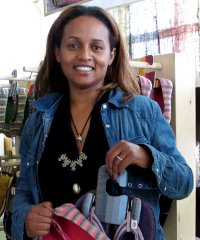
Bethlehem Tilahun Alemu
Bethlehem Tilahun Alemu-Ethiopia Entrepreneur
Alemu has become one of Africa’s most celebrated businesswomen. She was featured on the front cover of Forbes magazine in January 2012, and was selected as a “Young Global Leader” by the World Economic Forum 2011. In June 2012, she won the award for “Most Outstanding Businesswoman” at the annual African Business Awards, organised by African Business magazine.
Export-oriented success story
Her success with soleRebels is regularly cited as a sign that Ethiopia is ready to transition from being reliant on foreign aid to being able to direct its economic future by exploiting home grown skills, resources and business opportunities.
The company is also held up as inspiration for Ethiopia’s newly-emerging private sector, particularly as an example of an export oriented success story.
Alemu explained how she set up the company in a small village on the outskirts of Addis Ababa, “Having grown up watching our family and neighbours struggling, we decided to create the ‘better life’ we were all waiting for by harnessing our community’s incredible artisan skills and channeling them into a sustainable, global, fair trade, footwear business.”
She continued, “We selected shoes because we saw that footwear was an excellent platform to begin to share many of Ethiopia’s indigenous eco-sensible craft heritages and artisan talents with the world. Our approach to footwear creation – hand-crafted and eco-sensible – meant we could source and make almost all our materials locally, thereby creating an export product from 100% local inputs.”
Tyre-soled shoes
The soleRebels footwear range includes sandals, flip flops and shoes with soles made from recycled car tyres. Alemu explained that the recycled car tyre-soled shoe has existed in Ethiopia for a long time. “It was the footwear from back in the day when the original “soleRebels” fought off the invading forces and kept Ethiopia as the only African nation to never be colonised! We took this wonderful, indigenous, age-old recycling tradition and fused it with fantastic Ethiopian artisan crafts and excellent modern design sensibilities, and turned it into footwear that has universal flavour and appeal.”
She is proud of the production process, stating that all the company’s styles incorporate as much recycled and sustainable materials as possible, with ingredients like hand-spun and hand-loomed organic cotton fabrics, and natural fibres, including Abyssinian hemp and koba. However, she shuns the term, ‘green business’, stating that she regards it as something of a fad. “We are embracing these deeply sustainable and traditionally zero-carbon methods of production and materials because they are integral parts of Ethiopia’s cultural fabric, a tradition which we grew up within and feel passionate about preserving.”
Workers’ rights
SoleRebels is also setting a high standard for workers’ rights, providing 100% medical coverage for employees and their families and free doctor-run medical checks, as well as providing transport to and from the worksite for workers with disabilities. Alemu insists that workers are treated with respect, noting that on average the company’s 90 employees get paid four times the legal minimum wage and three times the industry average wage for similar work.
Unlike most companies in the apparel and footwear sector, soleRebels does not use a quota system. Alemu explained, “The quota system of work, endemic in the fashion business always struck us as truly demeaning. It is a system that shows no confidence that workers can be incentivised to achieve targets and it creates a hostile working environment. SoleRebels pays all workers based on negotiated wages that are subject to mutually agreed, company-wide goals. This means that we are all in it together in terms of making sure that deadlines are met and that top-notch product quality is always achieved.”
Expansion
In order to meet growing demand, the company is constructing a new production facility and when it is finished Alemu expects the workforce to grow in number to around 300 employees. “Built with indigenous, eco-sensible materials and employing 100% renewable and self-generating power, this first of its kind production facility will serve as a leading innovation centre, allowing us to develop the cultural wealth of the country, while simultaneously expanding and enhancing our own production capabilities.”
Alemu believes that her company can be emulated by others and help foster inclusive, sustainable development in Ethiopia. She said, “soleRebels is living proof that creating innovative world class products and trading them with the world is the best road to greater shared prosperity for developing nations like ours.”
She also sees lessons for the rest of Africa. “Today, Africa accounts for a mere two percent of global trade. If sub Saharan Africa were to increase that share by only one per cent, it would generate additional export revenues each year greater than the total amount of annual assistance that Africa currently receives. We simply need the opportunity to increase our market share, something every good, strong, global business seeks to do.”
This article was first published in UNIDO’s Making It magazine

Monday, 17 June 2013

GARDEN CITY: Largest Mall in East and Central Africa by ACTIS

IFC to inject Sh4bn in Thika Road Shopping Mall, Garden City comprise retail, leisure and residential segments

Posted in Business Daily Africa  |Thursday 9th May, 2013

London-based private equity firm Actis is planning to invest in a 130,000 m2 mixed use development in Kenya, which will host the largest retail mall in east Africa. The Garden City development will be located along the Nairobi-Thika road, a KSh. 27 billion (US$322 million) new highway.
This is the latest major commercial project to be announced ahead of the completion of the Thika highway in September. Thika is an industrial town about 40 km north-east of Nairobi. Actis is developing Garden City Mall on a 32-acre site that previously belonged to East African Breweries Limited.
Garden City is on Thika super highway. The upgraded road is expected to boost the demand for space at the mall. World Bank unit starts talks for loan and stake in Garden City on superhighway.
Actis has said Garden City will cost $150 million (Sh12.6 billion) over five years. The International Finance Corporation (IFC) is negotiating to inject Sh4.1 billion ($49.8 million) in Garden City Mall, a shopping complex conceptualised by private equity firm Actis.
The investment will be in form of a loan and equity stake in Actis, according to an IFC disclosure note seen by the Business Daily. Actis says that Garden City Mall, a development along the Thika Super Highway, will be the region’s biggest shopping complex.

Other firms that have eyed investments along the highway include supermarket chains Uchumi and Nakumatt, PepsiCo which is establishing KSh. 2.4 billion ($29 million) bottling plant, and European furniture chain IKEA. Several residential projects like Tatu City, Migaa, and Thika Green have also been inspired by the eight lane highway, which will ease traffic along the busy Nairobi-Thika road.
According to a press release from Actis, the retail mall will include a flagship store for Game, their first in Kenya. Detailed discussions are progressing with other foreign retailers looking to enter the rapidly-expanding Kenyan market, such as South African fashion group Foschini.
Other than the 50,000 m2 retail mall, Garden City will also accommodate state-of-the-art commercial premises, 500 new homes and a central park, offering family friendly leisure space for Kenyans and visitors to the city. The park will also house an outdoor events arena for the staging of concerts and shows.
“Garden City offers a rare opportunity to create a large scale, world-class development directly serving the needs of Kenyan businesses, homeowners and shoppers. We have been encouraged by the strong demand shown by both local and international retailers, who like us, see Garden City as a landmark destination in Nairobi and the east African region. The inclusion of the central park and our commitment to green building measures will burnish Actis’s reputation as sub-Saharan Africa’s most experienced private equity real estate investor,” said Michael Turner, Actis head for east Africa.
The project is expected to attract more foreign retailers into the Kenyan market. Garden City is likely to send prices skyrocketing in neighbouring areas along the Thika highway.
Charles Kibiru, the managing director of Thika Greens, a golf estate located in Thika, reckons that Kenya should expect similar investments along the highway.
“Thika highway is the place to go. It is a hinterland and foreign investors should put their money here. We welcome the Actis investment because it will bring services closer to the people and help decongest the Nairobi central business district,” said Kibiru.
The project, he added, will also lead to job creation and economic development by attracting foreign brands to Kenya.
“Construction is expected to commence in June 2013 and IFC is considering a loan of up to $40 million and providing up to $9.8 million in equity to the project,” says the IFC note. Ground breaking for the multi-billion shilling project was planned for December 2012, and completion projected for May 2014.
 Garden City is using a ‘green-by-design’ approach incorporating sustainability measures from the very beginning of the design process: current features under discussion include water recycling and rainwater harvesting, the installation of solar collectors and the extensive planting of indigenous trees and landscaping forming a central park. Actis has a track record of successful real estate projects in Kenya, including its office complex Nairobi Business Park.

Thursday, 25 April 2013

Affordable Homes beyond Nairobi with Hass Consult -Thika


 Thika Greens Limited, CEO and Co-founder Charles Kibiru

Properties in the Thika area, categorized as Nairobi's zone C, recorded the country's highest percentage increase in sales prices last year, at 22 percent, on an average that moved from Sh7.8 million in 2011 to Sh9.5 million in 2012/FILE 
Via Capital Business @All rights Reserved.  http://www.capitalfm.co.ke/business/2013/04/buyers-look-beyond-nairobi-for-affordable-homes/

NAIROBI, Kenya, Apr 24 – As land and housing prices in Nairobi continue to escalate, property developers in the metropolis are recording renewed sales strength driven by buyers’ search for affordable luxury living – across first, second and retirement homes.
Properties in the Thika area, categorized as Nairobi’s zone C, recorded the country’s highest percentage increase in sales prices last year, at 22 percent, on an average that moved from Sh7.8 million in 2011 to Sh9.5 million in 2012.
This compared with the almost flat pricing in the previously frenetic Zone A and B suburbs, where sale prices rose between 1 and 2 percent in 2012, according to The Hass Property Index, 2012 annual report.
Hass Consult further reported that the relatively flat sales prices in Nairobi’s mid-town areas of Westlands, Lavington, Riverside, Kilimani and the outer zone areas of Karen, Gigiri, Spring Valley, Lower Kabete, Hill View Estate, Kitisuru, Loresho, Runda and Komarock were a result of the previously steep rise in pricing now reaching the limits of consumers’ spending power.
CEO and Co-founder of Thika Greens Limited Charles Kibiru says that: “Buyers are not ready to spend say Sh35m for a 3 bedroom house in Nairobi’s Runda estate while they could get the same home at less than half price in secure, gated estates outside the city where commuting time has also been greatly reduced by the completion of the ultra-modern 42-kilometre Thika Superhighway.”
He added that increased buyer activity in Thika, which is now a 30 minutes’ drive from Nairobi’s Central Business District, has seen a rise in developers’ interests, with now more than five multi-million real estate projects coming up in a town synonymous with industrial and agricultural activities.
This surge is largely being driven by the increased interest in the affordable luxury lifestyle integrated in developments such as Thika Greens golf city, according to Kibiru.
“The high buying activity in Thika is driven by people who want to live in high-income residential estates in Nairobi, but the cost is three times higher than in developments such as Thika Greens where they can spend about Sh10 million to own a large home compared to Sh30m cost of a similar home in Westlands,” he explained.
“Our pool of customers range from first home owners, second and retirement home seekers, local investors and Kenyans in the Diaspora,” he said.
Thika Greens has been testament to the surging housing demand outside Nairobi.
In three years, the development, across three phases, has run ahead of its original schedule, with all plots in phase one now sold out, 50 percent of phase two sold and 65 percent of phase three sold.
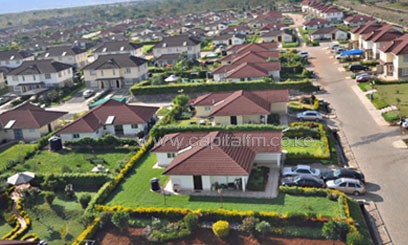
The premier golf estate houses an 18-hole championship golf course, private members’ clubhouse that is also open to non-residents, five and three star hotels, an office park, a world class shopping mall, community centre, retirement village, schools, a hospital and a police station.
“We offer home buyers a serene, luxurious and secure environment as we help actualise the social pillar of Vision 2030 to decongest Nairobi city and other urban centres,” Kibiru said.
He noted that buyers have also been attracted to Thika Greens by the flexible options across buying a built home or buying a plot to build a house to a controlled design.
“Buyers choice seems based on cost savings and convenience. In our phase one and phase three, 100 percent of the buyers are building their own houses, while phase two has attracted mixed interest, with 30 percent of the homes being made available for outright buying,” he said.
The serviced plots in phase one at Thika Greens which were costing a buyer Sh850,000 in 2009 have now appreciated in value to Sh2.2 million, those in phase two and three cost a buyer between Sh4.5 million and Sh7 million, and Sh2.5 million to Sh3 million, respectively.
According to Kibiru, building a house at Thika Greens is the most popular option with buyers as they stand to save and can invest in the building in progressive steps over time.
He confirmed that Thika Greens will deliver up to 4,000 new homes in this fast growing locality within Thika Municipality resulting in value creation of close to Sh60 billion, and thus providing a significant boost to the local economy.
Sales of the development began in 2009, with the focus in the last 2 years on infrastructure and amenities that are now catalyzing home constructions on the site.
About 40 km of the water piping and 33 km the roads have been constructed representing 100 percent of those in phase one and 80 percent of roads in phase two.
The development has so far taken in approximately 10 per cent of Sh53 billion, the estimated cost in investments by both the master developer and home builders, to develop the project to its current status.

Wednesday, 17 April 2013

Properties: Osero House, Amboseli, kenya with Knightfrank Kenya

Osero House adjacent to the Amboseli National Park Gate. 

It is an exclusive and luxurious property set at the foot of Mount Kilimanjaro,only 5Kms from Kenya's famous Amboseli National Park. *Price on Application
http://search.knightfrank.co.ke/kekn006260


- 121.8 hectares, freehold with more than 820m² living space. - Large family & living rooms and spacious dining area with picture windows,all with large open fire places - Spacious balconies and large terraces with great game viewing opportunities - 4 ensuite bedrooms - Swimming pool and Sauna - Special African Art Collection - Two wild-animal watering holes - 3 Staff quarters for more than 8 people
  • 24hr security
  • Balcony
  • Swimming Pool
  • Terrace 

Since its inception in 1998, Knight Frank Kenya (KFK) has grown to be a market leader in East Africa, offering leading advice and transaction support to investors, corporates and homeowners for their personal and business property needs. Whether searching for a luxury estate or commercial space, Knight Frank delivers a seamless service from start until completion. Property Agent Mercy Kareithi and Ben Woodhams
 http://www.knightfrank.co.ke/

Sunday, 10 February 2013

Social Culture: Patriotism Goes beyond Social Media


Author Vimal Shah @All Rights Reserved
Dear voters,
Do you know just how crucial your vote is to the future of this country? Why are some of you so indifferent to politics? Why is it that rather than get directly involved in politics you choose to take to social media to air your views?
Your apparent apathy to Kenya’s politics worries me. While I do agree with you that a lack of true leaders amongst many of our politicians is the reason this country is not as economically developed or as ethnically tolerant as it should be, your lack of interest in politics is also partly to blame for this leadership void.
Taking to Twitter and Facebook to ridicule politicians and whine about the loss of the ‘better candidate’ in the recently held party primaries cannot be defined as active involvement in politics or the running of the country; going out to vote can. As much as discussing so-and-so who shouts the loudest in and outside Parliament but has little to show for bettering his/her constituents shows that you have an idea of what is going on in the political arena, statements such as ‘I could not go out and vote because I didn’t have time’ show that you do not care for your country as much as you would like people to believe.
It is a shame that many in the middle class have taken a back seat when it comes to politics. You need to understand that your vote counts just as much as that of the politician and the low income earner, and that no election is too trivial for you. But you seem not to know this, which is why politicians always by-pass you in favour of the masses who are willing to cast their votes for those whose policies they know nothing about.
If you think I’m wrong, tell me: do politicians hold rallies in Kileleshwa or Karen? Why do they always retreat to the low income settlements if their inhabitants do not matter? They do this because they know you will not vote anyway!
A report released by the African Development Bank (AfDB) in January 2012 estimated the number of Kenya’s middle class at 17 percent of the population. Although this means that the middle class is by far out-numbered by low income earners (the World Bank estimates that 44 to 46 percent of Kenyans live below the poverty line), it also means that this class makes up a sizeable chunk of eligible voters.
The middle class can influence the direction this country takes just by being a little more interested in the political affairs of this country. It is not just about talking to your gated-community neighbours about how poorly run this country is; it is about positively influencing everybody you come into contact with, including the domestic workers and others you rely on to keep your home/office/business running.
Every day in our papers we read that Kenya’s middle class is growing, backed by figures that show, for example, that the number of personal vehicles on our roads doubled between 2002 and 2007. If that is true, then the influence of the middle class should also be growing. If the middle class contributes so much to this economy, shouldn’t this same class actively participate in the running of the same economy it helps fuel?
You cannot afford to scoff at the masses that attend mid-week rallies held by politicians, logging onto your social media profile to call these Kenyans ‘idle’ and point out that these Kenyans are there because they are jobless yet politicians do not care. Remember that these ‘idle’ Kenyans are the same ones incited to violence so they can earn a few shillings. Remember that these same Kenyans are willing to fight for what they believe in, be it right or wrong. Many of them are very smart young people who have not had any economic opportunity to partake in development.
Your indifference to politics is not a sign of your superiority over the ‘easily misguided’ masses. By hiding behind social media instead of queuing to vote, you are saying that you do not care about Kenya. By refusing to use your power to vote you are relinquishing any right to comment on the affairs of this country, be they social, economic or political.
As we head towards the March 4th 2013 general election you need to demonstrate that your patriotism is more than wearing a ‘Proud to be Kenyan’ T-shirt bought at your local mall. You need to show that you understand the Mkenya Daima campaign encouraging Kenyans to be ‘wenye nchi’ and not just ‘wana nchi.’
You have shown that you can use social media to make a difference, as evidenced by Twitter campaigns such as #Kenyans4Kenya. It is now time to get off social media and take action: be one of the voters who will queue to vote on March 4th. It is time to take the future of this country into your hands, and not only on your keyboard.
Our country needs you. Vote for integrity and vote for the people who you think will bring the change and the future that you desire – but please DO GO OUT AND VOTE!

(The writer is the vice chairman of KEPSA and chairman of the MKenya Daima steering committee)

Wednesday, 3 October 2012

Monday, 27 August 2012

An Ideal Office Culture For Travelling Entreprenuers

A nomadic entrepreneur, Amir Wald, 33, is the founder of Colnect.com, a unique platform for collectors available in 60 languages and currently visited by over 333,000 people a month. 

 It all started a little more than a year ago in my dull home city. I was selling my apartment and moving my things. When people asked where I was going to, I answered, “everywhere”. Surprised, they wondered “what about your start-up?”. I pointed to my backpack, “Colnect is coming with me, right here”. I ventured out into the world with a laptop, a smart phone, four Colnect T-shirts in four different colors, a box full of advertisement fliers that resemble dollar bills enough to make them a popular attraction almost anywhere on the planet and a puppet frog named Frognector. To date, I have been through 13 countries, camping around Iceland, hitchhiking through continental Europe, seeing the Orthodox Jewish New Year celebrations in Ukraine and shortly after attending Israel’s much less orthodox naked festival, staying in desert caves in Jordan, lying on the beaches of Goa in south India, settling for a while in the Tibetan refuge city in the mountains of north India and drinking fresh coconuts in Thailand. All the while running my start-up. My name is Amir Wald and I am an entrepreneur. Colnect is a unique website for collectors, available in 60 languages, that I built and am continuing to push forward. From any place that has an Internet connection, I keep managing hundreds of volunteers who help make Colnect the greatly needed service it is for the hundreds of thousands of people visiting it each month.


The Traveling Office

Every month, week or day my office door opens to a completely new place. The globe turns a bit, grinding beneath the floor tiles and comes to a screeching halt. The office room itself changes in the process as well, but what the heck, as long as it has a decent bathroom. This time the office door opens to a quiet green village in the mountains of Northern Laos, infested with plenty of unreasonably fairytale-like big butterflies. My breakfast is a fresh pineapple shake. My lunch and dinner are in a restaurant that is actually the bamboo home of a sweet elderly Laotian couple that put a big English menu on their door. They seem to really enjoy feeding me giant sizzling dishes. No coworker chatter, just laughing Laotians drinking Beer-Lao and the occasional Western tourists. No credit cards accepted here. Some of the chairs are replaced by pillows and hammocks. Although at the bottom of the mountain, it feels like the top of the world.

Thursday, 23 August 2012

Maasai Girl Jubilant Graduation runs Canada Media, Plus a Special & Most Valuable Gift in the Maasai Cultural Coffers for Ryerson University President.

TERIANO LESANCHA’S,22,  dream was to get an education, something that was elusive to many girls in her village in Kajiado. She, however, got more than she ever dreamt of, writes HELLEN MISEDA
University graduation is a big deal in Kenya and it calls for pomp and celebration with the media always present to capture the memorable moment. Jubilant jubilee 
This is not the case abroad and a graduation day is just like any other day. The media rarely show up for unless there is something extraordinary going on.
But on June 6, one simple Maasai girl managed to make graduation a big deal in Canada, capturing the attention of the local press and the university community.
On that day, big names like Toronto Star, CTV News and CBC News camped at the Ryerson University grounds to capture this inspiring story that sounded like a nicely written movie script.
Toronto Star ran the story on their front page on June 2 demonstrating how smitten the Canadian media was by this fascinating Maasai story.
So what is this big story that wowed the Canadian media so much that they gave it prominence and acres of space?
I came to learn of this beautiful story while on a three-week tour of Canadian universities sponsored by the Canadian High Commission in Kenya. Ryerson University was one of the institutions we toured and it was during the tour that I bumped into the Teriano tale.
This 22-year-old Maasai girl had a big dream when she was growing up in a little known village in Kajiado — she wanted to get an education and use it to build a meaningful life.
That ‘crazy dream’, as Teriano called it, seemed like it would never come true, considering that few in her poor village could even read or write.
Coming from a place where girl-child education is not valued, Teriano wanted to show her people that educating a girl was a worthy investment.
When she completed her secondary education and excelled with flying colours in 2008, she was lucky to get a sponsor who was willing to finance her education in one of the top universities in Canada — Ryerson University.
Teriano was a typical naive Maasai girl who had never even stepped in a big city like Nairobi. Now you can imagine the shock that met her when she landed at the Toronto Airport and into the fast-moving city.

Wednesday, 22 August 2012

Africa Awards for Entrepreneurship (AAE) 11 October 2012. Will You Be Next?

CHRIS KIRUBI TO JUDGE 2012 AFRICA AWARDS FOR ENTREPRENEURSHIP,


The African Leadership Network , Africa's premier network of new generation leaders, announced the judging panel of the prestigious 2012 Africa Awards for Entrepreneurship (AAE) . The panel is made up of 5 of Africa's leading entrepreneurs and business executives with illustrious records in building businesses and promoting entrepreneurship. They represent 4 African regions and collectively, bring more than 150 years of senior-level business experience and unrivalled business knowledge in Africa.

The members of the judging panel, whose profiles are attached, are:
1. Chris Kirubi , Serial Entrepreneur and Investor – Kenya
2. Ahmed Heikal , Founder and Chairman, Citadel Capital – Egypt
3. Divine Ndhlukula , Founder & CEO, Securico & Grand Prize Winner, AAE 2011 - Zimbabwe
4. Adedotun Sulaiman , Founder & Chairman, Arian Capital Management - Nigeria
5. Yvonne Ike , CEO, West Africa, Renaissance Group - Nigeria

Commenting on the announcement, Mr Fred Swaniker CEO of the African Leadership Network (ALN), said: "We are thrilled by their acceptance to serve as judges for the 2012 AAE and we commend their exemplary contribution to inspiring the next generation of entrepreneurs in Africa. The Africa Awards for Entrepreneurship are a powerful and prestigious platform to spotlight the best of the best among Africa's entrepreneurs."

The awards were previously owned and coordinated by the Legatum Group and are this year being managed by the African Leadership Network. The Awards Gala Ceremony will be held on 11 October 2012, in Accra, Ghana at the African Leadership Network's flagship yearly event, the ALN Annual Gathering. The awards will have four categories:

• Lifetime Achievement Award to be bestowed on a remarkable senior and iconic African business leader that has left an enduring legacy of decades of entrepreneurial success in Africa.
• Transformational Business Award to be awarded to an outstanding African entrepreneur who has built a company with revenues greater than USD 50 million.
• Outstanding Mature Business Award for a remarkable African entrepreneur with a business that has made revenues between USD 5 million – USD 50 million.
• Outstanding Small and Growing Business Award to be given to a stellar African entrepreneur with a business that has revenues between USD 500,000 and USD 5 million.

Comment on the announcement, Divine Ndhlukula, a member of the judging panel, and the Overall winner for the Awards last year, said:

"With the African Leadership Network taking the lead in the management and hosting of the awards, the awards should serve as a focal point for recognising and rallying the next generation of entrepreneurs in Africa. In its sixth year now, it is essential to see more African women entrepreneurs recognised for their achievements and I encourage people to nominate outstanding women entrepreneurs for the Awards."

The competition for the Awards opened 5 weeks ago and runs until 31 August 2012.

Friday, 17 August 2012

Kenya, Truly the Cradle of Mankind

Cradle of Mankind
  • Kenya has the largest number of fossil human remains appr. 1000 individuals than any other country in Africa.
  • Kenya has the oldest human remains going back to 7 million year old from Turgen Hills, Baringo (oldest in Ethiopia = 4.5 million years ; S.Africa ca 3 million years, Tanzania = 2 million years.
  • Kenya has some of the most complete skeletons e.g Turkana Boy (1.6 Million years), which provided a great wealth of information regarding early human physiology than anywhere in the world.
  • Kenya is endowed with many prehistory sites scattered all along the Rift Valley (north to south) and western Kenya.