Monday, 29 July 2013

Africa Property Investment Summit about African Real Estate Investment and Development: Sept 2013

Africa Property Investment Summit: 3-4 September 2013

BY | July 11, 2013 at 15:07 http://www.howwemadeitinafrica.com
If investment and development feature strongly on your business agenda, then this commercial property forum is not to be missed. An annual event, the African Property Investment Summit has earned the respect of the industry and is an anticipated event on the African real estate calendar.
The Africa Property Investment Summit is fast approaching with limited bookings available. The two-day event, taking place in Johannesburg from 3-4 September 2013, will be once again be held at the beautiful Sandton Sun Hotel.
This summit presents a professional platform for learning about African real estate investment and development. Following its success in 2011 and 2012, the summit returns with the support of more industry heavyweights and an agenda designed to draw the leading minds in the property arena.
This is a unique opportunity to discuss current trends, share industry experiences and enjoy insightful debate. If you are committed to an African growth strategy, this is a property event you cannot afford to miss.
This year’s event features an exciting line up of speakers and panel discussion participants actively doing deals across the continent.
The two day conference package (R7,950/$895) includes all lunches and refreshments, an invitation to the gala dinner, parking and full access to all research, presentations and documentations. For booking information and enquiries contact Muhammad Joosub on muhammad@apisummit.co.za or +27 11 593 2288 or visit www.apisummit.co.za

Friday, 26 July 2013

Nairobi’s Prime Real Estate Growing by 25% faster than Miami (19.1%), London (12.1%).

Kenya’s luxury property market records highest growth globally in 2011


Kenya’s luxury real estate saw the greatest price increase globally in 2011, according to Knight Frank’s Prime International Residential Index (PIRI), which monitors price changes across the world’s top-end property markets.
Price growth in both Kenya’s capital Nairobi and the country’s Indian Ocean coastal hot spots was more than any of the other global locations included in the Index, with the value of Nairobi’s prime real estate growing by 25% in 2011 and the Kenyan coast by 20%.
Knight Frank defines “prime property” as a location’s most desirable and usually most expensive real estate.
Kenyan luxury real estate prices grew faster than major cities such as Miami (19.1%), London (12.1%), Moscow (9.8%), New York (3.1%), Shanghai (-3.4%) and Singapore (-4.7%).
It should, however, be noted that Kenya’s growth comes from a base of relatively low luxury property prices. The average price per square metre of prime real estate in Nairobi is only US$1,700, which doesn’t even compare with cities such as Monaco ($58,300/sq m), London ($48,900/sq m), Beijing ($17,400/sq m) or Mumbai ($11,400/sq m).
Increasingly affluent buyers from emerging markets are boosting residential property prices in developed world locations such as Miami, London and Vancouver. “When asked which nationalities will become most important as prime property buyers over the next five years, Chinese, Russian, Middle Eastern, Latin American and those from other growth economies consistently top advisors’ lists,” notes Liam Bailey, head of residential research at Knight Frank.
The reason for this is that many of the newly rich in the developing world fear that issues such as corruption and politics can pose a risk to property investments in their home countries. They therefore prefer safe haven locations such as London, which has a cosmopolitan environment, good education and both personal and property security.
Bailey says that New Zealand’s isolation from the world’s conflict zones makes it possibly the ultimate safe haven destination for the world’s super-rich.
Although ‘safe haven’ isn’t necessarily a phrase many people would use to describe Kenya in a global context, compared to its neighbouring countries it is just that, commented Ben Woodhams, managing director of Knight Frank Kenya.
Woodhams added that Kenya’s fast economic development is attracting domestic and international private equity. However, recent events such as the kidnapping of tourists staying on Kenya’s north coast and a steep rise in interest rates to almost 25% also highlight the potential vulnerability of some emerging prime markets.
Saskia Sassen, co-chair of the Committee of Global Thought at Columbia University and the person who coined the term ‘global city’, said that Nairobi is becoming “increasingly important in a rapidly urbanising world”.

Monday, 22 July 2013

Women founding Big Companies in the Male Dominated Construction industry (SA)

How Rachel Tladi is making a name for herself in a male-dominated industry.


Rachel Tladi was 43 years old and working as an accountant when a client and friend challenged her to start her own construction company in South Africa. Under his mentorship, Tladi started Uvuko Civils, which was registered in 2002.
Rachel Tladi
Rachel Tladi
Uvuko Civils’ business is in building and construction and they have recently expanded the company, through a partnership with the Department of Public Works, to include repairs, maintenance and installations in the elevator industry. Uvuko Civils was founded and is wholly owned by Rachel Tladi, a determined and dynamic black woman with over 12years of experience in the civil and construction industry. http://www.uvukocivils.co.za/management.php
Last week Tladi was one of the guest speakers at the launch of the inaugural WIE Africa (which stands for Women, Inspiration and Enterprise) symposium in Cape Town, and took a moment to tell How we made it in Africa a bit about what it is like to be a woman in a typically male-dominated industry.
“You find that men [often] do not respect women and men do not believe that women can do the right thing [in business],” said Tladi. “For argument’s sake… when you have an argument and say, ‘no this is the wrong measurement,’ then they argue. They don’t take you seriously and in most cases, even when you are going to get funding, there is always an obstacle for women.”
However, in spite of the fact that Tladi feels she has to prove her business worth to men in the industry, she recognises that it was a man that actually convinced her to start her company in the first place and, in fact, provided her company with its first business. “He said, ‘this is what I am going to do, I’m going to give you a job to do for me for R250,000 and I will fund and will do everything so that you are successful’. And he took me along,” reflected Tladi.
Tladi’s success in business has been recognised in a number of awards. In 2008 she was awarded the Govan Mbeki Best Woman Builder of the Year award at both the provincial and national level. The following year she received the Provincial Govan Mbeki Woman Contractor of the Year award and in 2010 she was the recipient of the Regional Business Woman Achievers Award in the entrepreneur category, and a finalist at the World Entrepreneur Awards 2010.
Tladi is a firm believer in supporting and mentoring other aspiring business women. “How I assist other women in business is that I do skills development… and then I also do motivational talks to motivate women to be in business.”
While Tladi does feel that she is often discriminated against by men in the industry for being a woman, she feels that it can also be a challenge to instruct and mentor other women. She added that the problem with women leaders is that they don’t only face prejudice from men, but also from women, and Tladi believes that this can be a real problem for the advancement of women leaders in society.
“So the challenge as well is that you can’t give women instructions,” said Tladi. “You know, they feel that another woman is giving them an instruction and you want to take them along with you… And when you mentor a woman, you tell them about all these things, you say ‘you know when you get your first cheque you can’t go and buy something, you need to put it back into the business,’ and they think that you want to control them.”
Tladi believes that maintaining integrity and developing one’s skills are the most powerful pieces of advice she can give to other women looking to be successful in the industry, and in business in general.
“My number one advice to these women is that they must have workshops; they must work together, and have motivational talks as woman. And as a successful person, it’s not final. I’m still in a race… So for them, they must just have courage, to push to go open the door that you can’t open. And for them to be successful, they must not be afraid to ask ‘how do we do this?’ The most important thing for a woman is to have skills for them to get into this industry,” she added. “It’s not an easy industry.”

soleRebels: Africa’s largest footwear brands and transforming the economic landscape in Ethiopia

How soleRebels became one of Africa’s most celebrated footwear brands. http://www.solerebelsfootwear.co/#

An innovative footwear manufacturer that pays fair wages and uses locally sourced materials is helping to transform the economic landscape in Ethiopia. SoleRebels, which was founded by Bethlehem Tilahun Alemu in 2004, has become one of Africa’s largest footwear brands, with its range of artisan-made shoes now selling in 55 countries. In 2011, the company ramped up US$2 million in sales and it is expecting to generate over US$15-20 million in revenue by 2015.
Bethlehem Tilahun Alemu
Bethlehem Tilahun Alemu-Ethiopia Entrepreneur
Alemu has become one of Africa’s most celebrated businesswomen. She was featured on the front cover of Forbes magazine in January 2012, and was selected as a “Young Global Leader” by the World Economic Forum 2011. In June 2012, she won the award for “Most Outstanding Businesswoman” at the annual African Business Awards, organised by African Business magazine.
Export-oriented success story
Her success with soleRebels is regularly cited as a sign that Ethiopia is ready to transition from being reliant on foreign aid to being able to direct its economic future by exploiting home grown skills, resources and business opportunities.
The company is also held up as inspiration for Ethiopia’s newly-emerging private sector, particularly as an example of an export oriented success story.
Alemu explained how she set up the company in a small village on the outskirts of Addis Ababa, “Having grown up watching our family and neighbours struggling, we decided to create the ‘better life’ we were all waiting for by harnessing our community’s incredible artisan skills and channeling them into a sustainable, global, fair trade, footwear business.”
She continued, “We selected shoes because we saw that footwear was an excellent platform to begin to share many of Ethiopia’s indigenous eco-sensible craft heritages and artisan talents with the world. Our approach to footwear creation – hand-crafted and eco-sensible – meant we could source and make almost all our materials locally, thereby creating an export product from 100% local inputs.”
Tyre-soled shoes
The soleRebels footwear range includes sandals, flip flops and shoes with soles made from recycled car tyres. Alemu explained that the recycled car tyre-soled shoe has existed in Ethiopia for a long time. “It was the footwear from back in the day when the original “soleRebels” fought off the invading forces and kept Ethiopia as the only African nation to never be colonised! We took this wonderful, indigenous, age-old recycling tradition and fused it with fantastic Ethiopian artisan crafts and excellent modern design sensibilities, and turned it into footwear that has universal flavour and appeal.”
She is proud of the production process, stating that all the company’s styles incorporate as much recycled and sustainable materials as possible, with ingredients like hand-spun and hand-loomed organic cotton fabrics, and natural fibres, including Abyssinian hemp and koba. However, she shuns the term, ‘green business’, stating that she regards it as something of a fad. “We are embracing these deeply sustainable and traditionally zero-carbon methods of production and materials because they are integral parts of Ethiopia’s cultural fabric, a tradition which we grew up within and feel passionate about preserving.”
Workers’ rights
SoleRebels is also setting a high standard for workers’ rights, providing 100% medical coverage for employees and their families and free doctor-run medical checks, as well as providing transport to and from the worksite for workers with disabilities. Alemu insists that workers are treated with respect, noting that on average the company’s 90 employees get paid four times the legal minimum wage and three times the industry average wage for similar work.
Unlike most companies in the apparel and footwear sector, soleRebels does not use a quota system. Alemu explained, “The quota system of work, endemic in the fashion business always struck us as truly demeaning. It is a system that shows no confidence that workers can be incentivised to achieve targets and it creates a hostile working environment. SoleRebels pays all workers based on negotiated wages that are subject to mutually agreed, company-wide goals. This means that we are all in it together in terms of making sure that deadlines are met and that top-notch product quality is always achieved.”
Expansion
In order to meet growing demand, the company is constructing a new production facility and when it is finished Alemu expects the workforce to grow in number to around 300 employees. “Built with indigenous, eco-sensible materials and employing 100% renewable and self-generating power, this first of its kind production facility will serve as a leading innovation centre, allowing us to develop the cultural wealth of the country, while simultaneously expanding and enhancing our own production capabilities.”
Alemu believes that her company can be emulated by others and help foster inclusive, sustainable development in Ethiopia. She said, “soleRebels is living proof that creating innovative world class products and trading them with the world is the best road to greater shared prosperity for developing nations like ours.”
She also sees lessons for the rest of Africa. “Today, Africa accounts for a mere two percent of global trade. If sub Saharan Africa were to increase that share by only one per cent, it would generate additional export revenues each year greater than the total amount of annual assistance that Africa currently receives. We simply need the opportunity to increase our market share, something every good, strong, global business seeks to do.”
This article was first published in UNIDO’s Making It magazine

Sunday, 14 July 2013

The Top Six Biggest Companies In Kenya And Their Shareholders

Article by Kenyaentrepreneur    @ http://kenyaentrepreneur.hubpages.com/
In this hub I will be listing the top six biggest indigenous Kenyan companies and their shareholders (people who own them). In indigenous I mean the companies that have their roots in Kenya or in other words that were registered and incorporated in Kenya. The likes of Barclays bank of Kenya and Standard chartered Bank are excluded because their holding companies are foreign in nature meaning they are owned outside Kenya and therefore don’t qualify to be included here.
For now though, here below are the top 6 biggest companies in Kenya in no particular order

1. Kenya airways
Website: http://www.kenya-airways.com
C.E.O: Titus Naikuni
Founded in the year 1977 after the collapse of the east African community, Kenya airways is today one of the biggest national carriers in the African continent. With over 100 flight destinations worldwide, the pride of Africa as is commonly known is undoubtedly one of the biggest, finest and respected companies in Kenya and beyond. The airline is a public-private partnership company after privatization back in the year 1966. The airlines stock is traded in the Nairobi securities exchange and the top shareholders are as follows;
  • KLM has a 26% ownership
  • Government of Kenya- 23%
  • Paul Wanderi Ndungu- 3.32%
  • Barclays bank Kenya nominees limited 2.5%
  • Mansukhlal Khetshi Shah 2.03%
  • Kumar Shah 1.26%
  • Khetshi Dharamshi and company limited 1.13%
  • Rameshchandra Shah 1.01%
  • Apollo insurance company limited 0.94%
  • Shah Mahendra Shah 0.92%

2. Safaricom limited
Website: http://www.safaricom.co.ke
C.E.O: Bob Collymore
With over 18 million subscribers safaricom is the mobile phone and communications provider of choice in Kenya and as such the company is the biggest company not only in Kenya but in the east and central Africa region. Safaricom may not be offering cheaper calling rates like its competitors like Airtel and Orange but what has made them the darling of Kenya mobile phone users is the award winning M-pesa service (mobile money transfer service). One can transfer as little as ksh.100 to as much as ksh. 200,000 in a day from one mobile phone to another and withdrawals can be done any of the nearest over 20,000 agent outlets across the country at a very affordable rate.
The company’s main products that generate chunk of its revenue are voice, data and mobile money transfer services. U.K telecommunication company, Vodafone owns 40% of safaricom limited while the remaining 60% is owned by individual and corporate investors who are mostly Kenyans.

3. East African breweries limited
Website: http://www.eabl.com
C.E.O: Seni Adetu
Founded in 1922 east African breweries is one of the biggest companies in Kenya and the east African region. The Ruaraka based alcoholic beverage manufacturer produces some of the top beer and wine brands in Kenya and this is testified by the presence of its products in every Kenyan bar. The company’s biggest shareholder is Diageo plc of the United Kingdom. The top shareholders of eabl are as follows
  • Diageo Kenya limited 42.82%
  • N.S.S.F board of trustees 4.82%
  • Diageo holdings 4.60%
  • Barclays Kenya nominees account 3.06%
  • Guinness Overseas limited 2.61%
  • Karsandas babla 2%
  • Kenya reinsurance corporation limited 1.38%
4. Kenya commercial bank limited
Website: http://www.kcbbankgroup.com
C.E.O: Martin Oduor Otieno
Kenya commercial bank is the banking and financial service provider of choice for many individual, business as well as corporate customers in Kenya and the larger east African community region. With assets of over $2.65 billion and a branch network of over 168 branches in Kenya alone KCB is truly one of the biggest brands in Kenya. Share stocks of Kenya commercial bank are listed in the Nairobi securities exchange as well as cross listed in Uganda securities exchange, Rwanda stock exchange and Dar-es-salaam stock exchange.
The top shareholders of Kenya commercial bank are as follows;
  • Government of Kenya 26.23%
  • Icdc investment company 5.04%
  • N.S.S.F 4.74%
  • Kcb staff pension fund 3.43%
  • Sunil Narshi Shah 2.23%
  • Cfc stanbic nominees 1.53%

5. Equity bank limited
Website: http://www.equitybank.co.ke
C.E.O: James Mwangi
Like KCB, Equity bank limited is an indigenous Kenyan bank which started as a building society back in the year 1984. Since then the bank hasn’t looked about and today it boasts of an asset base of U.S$1.7 billion and over 6 million customer base. Although it provides the same services as other commercial banks in Kenya, what differentiates Equity bank from other Kenyan financial service providers is its business portfolio that mostly targets the low income earners in the Kenya economy.
Majority of the bank’s customers are individuals who are in the lower income bracket whom it continuously provides them with cheap financial products like loans and mortgages. This business initiative has enabled many poor people access affordable loans that may contribute to their lives in one way or another. Equity bank’s efforts haven’t gone unnoticed and that is why the bank has won many local and international awards. It was named the best performing company in Africa during the annual African investor index awards that was held in New York City in the year 2009. Euromoney also voted the bank as the best in Kenya in the year 2008.
Equity banks top shareholders are as follows;
  • British American Investment Company 14.75%
  • Nelson Muguku Njoroge 8.3%
  • James Mwangi (current C.E.O) 7.32%
  • John Kagema Mwangi 6.29%
  • Equity bank employees 5.52%
  • Africap limited 5.52%
  • Andrew Kimani 4.02%
  • Fortress Highlands Limited 3.72%
  • Peter Munga 3.2%
  • Mary Wamae 1.97%
6. Nation media group
Website: http://www.nationmedia.com
C.E.O: Linus Gitahi
Nation media group is the undisputed top media company in east and central Africa. Headquartered in nation centre along Kimathi Street in Nairobi central business district, the media house is the leader in print and electronic media across the east African region. The company has subsidiaries in both Uganda and Tanzania. In Kenya nation media group owns the popular Daily Nation newspaper, Business Daily newspaper, The East African, NTV, Easy fm and Q fm. In Uganda it has the Sunday Monitor newspaper, ntv Uganda. In Tanzania it has the Mwananchi newspaper. The Nation Media Group is a project of the Aga Khan and he is believed to be the majority shareholder.

Thursday, 27 June 2013

Property: India’s Richest Business Mukesh Ambani Cashes on Kenya Real Estate Boom

Mukesh Ambani cashes in on Kenya’s real estate boom
by Jun 27, 2013 
Ben Woodhams, Managing Director at KnightFrank
http://rm.co.ke/blog/kenya-property-news/mukesh-ambani-cashes-in-on-kenyas-real-estate-boom/

India’s commercial real estate maybe in doldrums but in Kenya, Nairobi has witnessed the fastest growth rate in rentals for high-end commercial property in 2012. And guess who is cashing in on this real estate boom?
Yup, it is India’s richest business man Mukesh Ambani.
According to a report in the Hindu Business Line, Ambani-owned Reliance Industries has bought 10 prime land plots in  Nairobi, for around Rs 202 crore ($33.9 million) for commercial and residential  development as agricultural land here is cheaper than residential. This deal was jointly inked by RIL and its subsidiary Delta Corp East Africa Limited (DCEAL).
Source:Knight Frank
Source:Knight Frank
This is not Ambai’s first tryst with real estate in Kenya. He had previously also acquired and developed prime plots within Nairobi which were either sold or rented to international organisations, private firms and government agencies. RIL Group holds a 60% stake in the joint venture with Delta Corp which had in 2008 more than one million square feet of land at various stages of development.
Ambani has been slowly  upping his interest in East Africa, and with rising demands for both commercial and residential spaces, Ambani is cashing in by building office towers in Nairobi’s Upper Hill and Westlands areas.
In fact, Reliance Industries has sold two properties in Nairobi–Delta Centre (Upper Hill), which was sold to the World Bank, and Delta Towers (Westlands), which was sold to the University of Nairobi and PricewaterhouseCoopers.
According to Mentor Group, a real estate firm, Upper Hill and Westlands will contribute 70 per cent of the 1.7 million square feet of office space that will come into the market annually over the next two years, with Upper Hill expected to record a temporary office space supply glut in 2015.
A survey by Economist Intelligence Unit (EIU), the research arm of the Economist, ranked Nairobi 112 among the 120 most promising global cities of the next decade, based on parameters like the city’s economic strength, financial maturity, physical capital, human capital, global appeal etc.
“In its broadest form, competitiveness is defined as a city’s ability to attract capital, businesses, talent and people. The Index benchmarks the competitiveness of cities at two points in time: today and in 2025,” said the report. According to the report, Nairobi’s profile as a regional business hub has been growing as seen by the number multinationals, from diverse industries, which have chosen to open shop in the Kenyan capital or decided to choose the city as their base for Africa-wide operations.
However, infrastructure is still the biggest laggard for the city. According to a report by global real estate consultancy firm Knight Frank, poor roads, interrupted water and power supplies are hindering the city from achieving a higher rank.
The list of multinationals that have recently set base in Nairobi include General Electric, Google, IBM, Visa International, Pepsi, Nestle, Foton Automobiles, Bank of India and HSBC. According to Knight Frank, companies relocating their regional headquarters to Nairobi are flying in a large number of expatriates, feeding the high-end market for residential property.
“A significant proportion of the recent take-up has been due to large corporates setting up regional headquarters in Nairobi, in preference to the traditional regional hub of Johannesburg,” said Ben Woodhams, Managing Director at KnightFrank in its Africa Report 2013, adding that in 2012, office space rent in Nairobi’s high-end areas rose 17.9 percent against the 5.1 percent global average.
But this real estate boom, is proving to be a bane for the agriculture sector as developers argue that it makes more business sense to build homes on lush farmlands. Agriculturalists, on the other hand, argue that urban expansion is threatening the  sector which is a key source of exports and forex for the  country.

Monday, 17 June 2013

GARDEN CITY: Largest Mall in East and Central Africa by ACTIS

IFC to inject Sh4bn in Thika Road Shopping Mall, Garden City comprise retail, leisure and residential segments

Posted in Business Daily Africa  |Thursday 9th May, 2013

London-based private equity firm Actis is planning to invest in a 130,000 m2 mixed use development in Kenya, which will host the largest retail mall in east Africa. The Garden City development will be located along the Nairobi-Thika road, a KSh. 27 billion (US$322 million) new highway.
This is the latest major commercial project to be announced ahead of the completion of the Thika highway in September. Thika is an industrial town about 40 km north-east of Nairobi. Actis is developing Garden City Mall on a 32-acre site that previously belonged to East African Breweries Limited.
Garden City is on Thika super highway. The upgraded road is expected to boost the demand for space at the mall. World Bank unit starts talks for loan and stake in Garden City on superhighway.
Actis has said Garden City will cost $150 million (Sh12.6 billion) over five years. The International Finance Corporation (IFC) is negotiating to inject Sh4.1 billion ($49.8 million) in Garden City Mall, a shopping complex conceptualised by private equity firm Actis.
The investment will be in form of a loan and equity stake in Actis, according to an IFC disclosure note seen by the Business Daily. Actis says that Garden City Mall, a development along the Thika Super Highway, will be the region’s biggest shopping complex.

Other firms that have eyed investments along the highway include supermarket chains Uchumi and Nakumatt, PepsiCo which is establishing KSh. 2.4 billion ($29 million) bottling plant, and European furniture chain IKEA. Several residential projects like Tatu City, Migaa, and Thika Green have also been inspired by the eight lane highway, which will ease traffic along the busy Nairobi-Thika road.
According to a press release from Actis, the retail mall will include a flagship store for Game, their first in Kenya. Detailed discussions are progressing with other foreign retailers looking to enter the rapidly-expanding Kenyan market, such as South African fashion group Foschini.
Other than the 50,000 m2 retail mall, Garden City will also accommodate state-of-the-art commercial premises, 500 new homes and a central park, offering family friendly leisure space for Kenyans and visitors to the city. The park will also house an outdoor events arena for the staging of concerts and shows.
“Garden City offers a rare opportunity to create a large scale, world-class development directly serving the needs of Kenyan businesses, homeowners and shoppers. We have been encouraged by the strong demand shown by both local and international retailers, who like us, see Garden City as a landmark destination in Nairobi and the east African region. The inclusion of the central park and our commitment to green building measures will burnish Actis’s reputation as sub-Saharan Africa’s most experienced private equity real estate investor,” said Michael Turner, Actis head for east Africa.
The project is expected to attract more foreign retailers into the Kenyan market. Garden City is likely to send prices skyrocketing in neighbouring areas along the Thika highway.
Charles Kibiru, the managing director of Thika Greens, a golf estate located in Thika, reckons that Kenya should expect similar investments along the highway.
“Thika highway is the place to go. It is a hinterland and foreign investors should put their money here. We welcome the Actis investment because it will bring services closer to the people and help decongest the Nairobi central business district,” said Kibiru.
The project, he added, will also lead to job creation and economic development by attracting foreign brands to Kenya.
“Construction is expected to commence in June 2013 and IFC is considering a loan of up to $40 million and providing up to $9.8 million in equity to the project,” says the IFC note. Ground breaking for the multi-billion shilling project was planned for December 2012, and completion projected for May 2014.
 Garden City is using a ‘green-by-design’ approach incorporating sustainability measures from the very beginning of the design process: current features under discussion include water recycling and rainwater harvesting, the installation of solar collectors and the extensive planting of indigenous trees and landscaping forming a central park. Actis has a track record of successful real estate projects in Kenya, including its office complex Nairobi Business Park.

Friday, 26 April 2013

Bahati Ridge Development -Thika town’s premier gated community http://bahatiridge.co.ke

Bahati Ridge Homeowners

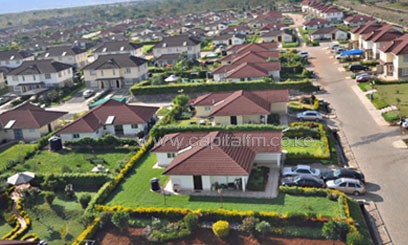
Bahati means luck in Swahili, and that’s what the homeowners on a 90-acre land will get. Originally a coffee estate that the chairman of the project, Mr. Joseph Kibe, bought in 1974 and later transformed into a horticultural farm growing French beans, the housing project will be home to 337 families on completion. Situated in Thika, a mere 45-minute drive from Nairobi's Central Business District (30 minutes on the soon-to-be completed eight lane super-highway), Bahati Ridge presents an exciting selection of townhouses, villas, bungalows and cottages that feature beautiful hill country views, a tranquil rural ambience and a refreshing escape from city chaos. Discerning homeowners will love this 97 acre integrated gated community and all the benefits of country living.

 Bahati Ridge Development Phases 1-4

 
Who owns Bahati Ridge?

Bahati Ridge Development Ltd owns 180 acres of farm property in Thika. The land is popularly known as Bahati Farm. Thika town is about 40 kms north of Nairobi, and is the headquarters of Thika District. Thika is well known for the Chania Falls, Thika Falls and the Ol Donyo Sabuk National Park.

What does the client intend to do with the property?

The directors intend to construct 337 low, medium and high density residential properties together with commercial properties (mixed user development) on 90 acres.
      NEWS!!!    NEWS!!!
Current Bahati Ridge Residential Property Show: Join us this weekend May 2013 for our 2nd Open Day from Thursday 2nd to Sunday 5th of May from 8am - 5pm. Lovely manicured country homes, amazing offers and prizes to be won don't miss out!!! Olengai Townhouse, Bahati Ridge! with Bahati Ridge, Maina Kageni, HassConsult RealEstate, The Property Guide, The Kenya Homes Expo @Bahati Ridge -Thika, Your Paradise Within Grasp! http://buff.ly/12TIu23

1)Olengai TownHouse: Outside is a 2 car parking space, Kitchen yard, a single servant’s quarters, an underground water tank, water pump, a cosy garden and paved walkways. As you ascend to the first floor, you can relax in any of the other 3 Bedrooms, including the en suite Master Bedroom, set apart in your own private space. Olengai TownHouse!

2)At Bahati Ridge we create an environment that allows you to enjoy tranquility, peace of mind and nature.Osotua Villas!
3)The noise and haste of metropolitan Nairobi may fire up your drive to succeed, but your soul also seeks equilibrium in a tranquil setting.Bahati Ridge is ... your paradise within grasp! Eseriani Bungalows!

Who is on the board of Bahati Ridge Development Company?

Mr. Joseph Kibe is the Chairman; Mr. Gilbert Kibe is the Managing Director of Bahati Ridge Development Limited. Other Directors are, Mrs. Monica Kibe, Mr. Victor Kibe, Ms. Margaret Kibe, Mrs. Josephine Kibe and Mrs. Grace Kibe.

What is 'Bahati Ridges' target market?

Bahati Ridge is a unique, middle income integrated development in Thika on 90 acres of land. The focus of the development is a holistic, wholesome lifestyle that combines residences, shopping, recreational and office facilities. Bahati Ridge is a flagship project for Kenya. The development is designed to set new standards and will be marketed as a destination address.
Pictured below: Bahati Ridge welcomed home lovers to join them at their Open Day from the 23rd to 25th of November 2012.  Meet your neighbors and experience the Country Living Lifestyle, unique to Bahati Ridge, Thika.

 Now you can live your dream at Bahati Ridge: your paradise is within grasp!

What is expected population size of 'Bahati Ridges'?

The master plan, road, water and power networks have all taken into account the expected population in both the residential and commercial facilities of the project. The residential population is expected to be about 2,000 people housed in 337 homes while the commercial population will be roughly 500 people: 200 in the school, 200 in the hospital and 100 staff overall. This gives a total population of about 2,500 people. Vehicle population is expected to be about 700 cars for the residences and 100 cars for the commercial population.

What about the community?

The integrated project has been designed with convenience and security consideration. Within the 95 acre gated community are smaller neighbourhoods/courts with additional perimeter security. In close proximity to the development will be a retail centre, nursery school, hospital, chief's camp and police post.

What are some of the design features of Bahati Ridge?

Bahati Ridge's unique features include: 

  • Man-made lakes by the club house, office block and shopping mall
  • Water features and/or green spaces in each court
  • Beautifully landscaped common areas and open spaces
  • Cabro walkways and driveways.
  • Solar powered street lighting
  • Electrified environmentally-friendly parameter fence
  • 24-hour security patrols & CCTV
  • Fibre optic underground wiring
  • Intercom systems and panic buttons in each home
  • Data and cable-ready homes
  • Double entry transition gate into property
  • Double entry main security gate with security office
  • Double gate into each court with guard house
Housing Minister, Hon. Soita Shitanda, Hon. Peter Kenneth, Gatanga MP and assistant minister ministry of Planning and Vision 2030 with the chairman Bahati Ridge, Mr. Joseph Kibe were participants during the project launch.

Culture & Architecture

  Bahati ridge Development Villas and Bungalows model designs 
A mixture of Thika, Green Culture and Great Architecture 

Who are the team of consultants & Architects?

  • Project Managers - Pinnacle Projects
  • Architects - Dimensions Architects
  • Quantity Surveyors - Costwise Associates
  • Civil & Structural Engineers - Xenocon Consulting Engineers
  • Mechanical & Electrical Engineers - Servconsult
  • Physical Planners; Environmental Experts - Townscape Consulting Planners
  • Branding & Marketing Consultants - Divergys Limited
  • Website Consultant - Ali Hussein
  • Advocates - Wainaina Ireri & Mwaniki Gachoka
  • Tax Consultants - DCDM
  • Graphics Design - Sketches Multimedia
  • Graphic Animation – Peter and Simon Dawa
Persons Behind the project Vision 2030
Designed to run in four phases, this is one of the biggest private sector initiatives that fully captures the aspirations of the government’s Vision 2030. The consortia undertaking the project include Lee Karuri, a Nairobi-based architect and director, Dimensions Architects & Interior Designers who are confident that the project will be completed on schedule and within cost and have set strict timelines to deliver.
“For those keen to invest in secure, serene homes complete with all amenities within reach, this is it,” said Mr. Gilbert Kibe, Managing Director, Bahati Ridge. Epco Builders, a reputable company that has successfully completed over 150 major construction projects in the region since 1977, is undertaking the construction work.
The project was launched  at the National Museums of Kenya auditorium Soita Shitanda, Minister for Housing, who said it will be Thika town’s premier gated community. “This project is designed for a broad spectrum of people and will not only help decongest Thika Road but is a model development that needs to be emulated elsewhere,’’ said the minister.
With the project, the benefits of Thika superhighway, East Africa’s model road construction project, have started to emerge. The houses featuring townhouses, villas and bungalows will have a price range of between Sh9 million to Sh15.5million.
A quick glimpse of the interior designs of one of the house categories, Townhouses and Osotua Villas, reveals a meticulously well thought-out plan. A spacious ground floor foyer leads to a guest bedroom, a dining area, a kitchen and an optional attic/study room on the top floor. It also opens up into a lounge with a fireplace that overlooks a terrace where you and your family can enjoy the natural scenery with fresh air and occasional weaverbirds singing. On the first floor you can rest in the privacy of three bedrooms, all ensuite!


To secure the gated community, nothing has been left to chance. The developers have made provision for a police post to enforce 24-hour police patrols.
“Bahati Ridge is an environmentally friendly project that will have a water treatment recycling plant, a rain water harvesting capability and all the houses will be fitted with solar equipment to help supplement the family’s energy requirements,” said Ms Margaret Kibe, the project’s marketing and communications director.
The lead financier and mortgage provider for the project is Commercial Bank of Africa. Other mortgage providers include Housing Finance, Kenya Commercial Bank, S&L mortgages, CFC Stanbic Bank and Family Bank.
The housing project, whose foundation stone was laid in June this year, will incorporate all essential social amenities including an ultra-modern shopping mall complete with a supermarket, restaurants and cafes. It will have an educational centre, medical centre, boutiques, wellness centre, clubhouse and pavilion.

For Sales enquiries Contact:
Margaret W. Kibe
Marketing & Communications Director
Bahati Ridge Development
Tel: 020-8155380/0717049644
Email: info@bahatiridge.co.ke
www.bahatiridge.co.ke

Contact Us
Bahati Ridge Development Ltd Thika
P.O. Box 47739-00100 Nairobi
Tel: +254 20 815 5380 Fax: +254 20 815 5381
Mobile: +254 717 049 644, +254 737 149 644
Email for General Enquiries: info@bahatiridge.co.ke
Email for Sales Enquiries: sales@bahatiridge.co.ke
www.bahatiridge.co.ke
SMS: Sms the word 'BAHATIRIDGE' to 3841
Follow @bahatiridge for updates
Visit our Facebook page here

Thursday, 25 April 2013

Affordable Homes beyond Nairobi with Hass Consult -Thika


 Thika Greens Limited, CEO and Co-founder Charles Kibiru

Properties in the Thika area, categorized as Nairobi's zone C, recorded the country's highest percentage increase in sales prices last year, at 22 percent, on an average that moved from Sh7.8 million in 2011 to Sh9.5 million in 2012/FILE 
Via Capital Business @All rights Reserved.  http://www.capitalfm.co.ke/business/2013/04/buyers-look-beyond-nairobi-for-affordable-homes/

NAIROBI, Kenya, Apr 24 – As land and housing prices in Nairobi continue to escalate, property developers in the metropolis are recording renewed sales strength driven by buyers’ search for affordable luxury living – across first, second and retirement homes.
Properties in the Thika area, categorized as Nairobi’s zone C, recorded the country’s highest percentage increase in sales prices last year, at 22 percent, on an average that moved from Sh7.8 million in 2011 to Sh9.5 million in 2012.
This compared with the almost flat pricing in the previously frenetic Zone A and B suburbs, where sale prices rose between 1 and 2 percent in 2012, according to The Hass Property Index, 2012 annual report.
Hass Consult further reported that the relatively flat sales prices in Nairobi’s mid-town areas of Westlands, Lavington, Riverside, Kilimani and the outer zone areas of Karen, Gigiri, Spring Valley, Lower Kabete, Hill View Estate, Kitisuru, Loresho, Runda and Komarock were a result of the previously steep rise in pricing now reaching the limits of consumers’ spending power.
CEO and Co-founder of Thika Greens Limited Charles Kibiru says that: “Buyers are not ready to spend say Sh35m for a 3 bedroom house in Nairobi’s Runda estate while they could get the same home at less than half price in secure, gated estates outside the city where commuting time has also been greatly reduced by the completion of the ultra-modern 42-kilometre Thika Superhighway.”
He added that increased buyer activity in Thika, which is now a 30 minutes’ drive from Nairobi’s Central Business District, has seen a rise in developers’ interests, with now more than five multi-million real estate projects coming up in a town synonymous with industrial and agricultural activities.
This surge is largely being driven by the increased interest in the affordable luxury lifestyle integrated in developments such as Thika Greens golf city, according to Kibiru.
“The high buying activity in Thika is driven by people who want to live in high-income residential estates in Nairobi, but the cost is three times higher than in developments such as Thika Greens where they can spend about Sh10 million to own a large home compared to Sh30m cost of a similar home in Westlands,” he explained.
“Our pool of customers range from first home owners, second and retirement home seekers, local investors and Kenyans in the Diaspora,” he said.
Thika Greens has been testament to the surging housing demand outside Nairobi.
In three years, the development, across three phases, has run ahead of its original schedule, with all plots in phase one now sold out, 50 percent of phase two sold and 65 percent of phase three sold.
The premier golf estate houses an 18-hole championship golf course, private members’ clubhouse that is also open to non-residents, five and three star hotels, an office park, a world class shopping mall, community centre, retirement village, schools, a hospital and a police station.
“We offer home buyers a serene, luxurious and secure environment as we help actualise the social pillar of Vision 2030 to decongest Nairobi city and other urban centres,” Kibiru said.
He noted that buyers have also been attracted to Thika Greens by the flexible options across buying a built home or buying a plot to build a house to a controlled design.
“Buyers choice seems based on cost savings and convenience. In our phase one and phase three, 100 percent of the buyers are building their own houses, while phase two has attracted mixed interest, with 30 percent of the homes being made available for outright buying,” he said.
The serviced plots in phase one at Thika Greens which were costing a buyer Sh850,000 in 2009 have now appreciated in value to Sh2.2 million, those in phase two and three cost a buyer between Sh4.5 million and Sh7 million, and Sh2.5 million to Sh3 million, respectively.
According to Kibiru, building a house at Thika Greens is the most popular option with buyers as they stand to save and can invest in the building in progressive steps over time.
He confirmed that Thika Greens will deliver up to 4,000 new homes in this fast growing locality within Thika Municipality resulting in value creation of close to Sh60 billion, and thus providing a significant boost to the local economy.
Sales of the development began in 2009, with the focus in the last 2 years on infrastructure and amenities that are now catalyzing home constructions on the site.
About 40 km of the water piping and 33 km the roads have been constructed representing 100 percent of those in phase one and 80 percent of roads in phase two.
The development has so far taken in approximately 10 per cent of Sh53 billion, the estimated cost in investments by both the master developer and home builders, to develop the project to its current status.

Wednesday, 17 April 2013

Properties: Osero House, Amboseli, kenya with Knightfrank Kenya

Osero House adjacent to the Amboseli National Park Gate. 

It is an exclusive and luxurious property set at the foot of Mount Kilimanjaro,only 5Kms from Kenya's famous Amboseli National Park. *Price on Application
http://search.knightfrank.co.ke/kekn006260


- 121.8 hectares, freehold with more than 820m² living space. - Large family & living rooms and spacious dining area with picture windows,all with large open fire places - Spacious balconies and large terraces with great game viewing opportunities - 4 ensuite bedrooms - Swimming pool and Sauna - Special African Art Collection - Two wild-animal watering holes - 3 Staff quarters for more than 8 people
  • 24hr security
  • Balcony
  • Swimming Pool
  • Terrace 

Since its inception in 1998, Knight Frank Kenya (KFK) has grown to be a market leader in East Africa, offering leading advice and transaction support to investors, corporates and homeowners for their personal and business property needs. Whether searching for a luxury estate or commercial space, Knight Frank delivers a seamless service from start until completion. Property Agent Mercy Kareithi and Ben Woodhams
 http://www.knightfrank.co.ke/

Monday, 15 April 2013

Bahati Ridge Development Properties. Your Paradise Within Grasp!

Properties: Bahati Ridge Homes. Your Paradise Within Grasp!

All journeys eventually end in the same place, home. ~ Chris Geiger 


Properties: Villas, bungalows and cottages that feature beautiful hill country views, tranquil rural ambiance and refreshing escape from city chaos and lassitude.
Property Development, Architecture & Management; BahatiRidge ©All Rights Reserved


The semi-detached Olengai Townhouses all feature an open plan lounge and dining area, a modern kitchen and four bedrooms. The guest bedroom, located downstairs, comes with its own en suite bathroom. As you ascend to the first floor, you can relax in any of the other three bedrooms, including the master bedroom with en suite bathroom, set apart in your own private space.
Outside is a two-car parking space, kitchen yard, a single servant’s quarters, an underground water tank, water pump, a cosy garden and paved walkways.

No of Total Units       = 52
Units in Phase 1        = 52
Areas:
o  TOTAL               = 142M2
o  Plot Acreage        = Aprox 0.085 Acres
Olengai Townhouses each feature an open plan lounge and dining area, a modern kitchen, and a guest bedroom. As you ascend to the first floor, you can relax in any of the four bedrooms – all with bathrooms en suite, set apart in your own private
space. The outside environs of a townhouse has a two car parking space, kitchen yard, a single DSQ, an underground water tank, a snug garden and paved walkways.
Payment Options

OPTION 1 OPTION 2 OPTION 3
Cash KES Cash Installments KES Mortgage* KES
10.5 million 11 million 11.5 million
50% Down Payment at Signing of Letter of Offer
40% Payment after signing of Sales Agreement
10% at handover of the property
20% Down Payment at Signing of Letter of Offer
20% At Signing of Sales Agreement
3 (Three) Payments of  20% at agreed periods until handover of the property
20% Down Payment to Bahati Ridge Development Ltd.
80% Balance paid by Bank at handover of the property

*Bahati Ridge Development Ltd. have negotiated a preferential interest rate with Commercial Bank of Africa: 2% below base rate

Monday, 25 March 2013

8 Kenyan Entrepreneurs Listed in Forbes Top 30 Under 30


The young African entrepreneurs, disruptor and innovators

Eight young Kenyans under the age of 30 years have made it to the elite list of Forbes top 30 under 30. The seven gentlemen and one lady have been feted for their exceptional performance and exemplary service in different industries.

“The young African entrepreneurs, disruptors and innovators featured on this list are impatient to change Africa and together represent the entrepreneurial, innovative and intellectual best of their generation,” said Mr. Mfonobong Nsehe a writer at www.forbes.com.

An outside panel of 12 judges from across Africa was picked to help identify the group of outstanding entrepreneurs and innovators under the age of 30, in November last year according to Nsehe.  In each of 15 categories, ranging from technology, real estate to social entrepreneurs, Forbes editors and reporters together with judges choose the field’s brightest stars who are individually most surprising, engaging, and hard working.

The eight Kenyans include:
Evans Wadongo
Chairman, SDFA Kenya
“Wadongo, a 26 year-old Kenyan engineer designed a solar-powered LED lantern called MwangaBora (Swahili for “Good Light”), an invention which is fast replacing smoky kerosene lamps and firelight in rural Kenya. Wadongo has been distributing thousands of these lanterns throughout rural Kenya where there is little or no electricity. His organization, Sustainable Development For All (SDFA) sponsors an empowerment initiative that teaches poor Kenyans how to reproduce these solar lanterns and sell for profit.” Forbes
.
Cosmas Ochieng, Founder, Ecofuels Kenya
Cosmas Ochieng, a 26 year-old Kenyan entrepreneur runs Ecofuels Kenya, an East Africa firm which produces environmentally friendly, green biofuels and organic fertilizers from renewable indigenous sources such as the croton nut.
Two Kenyan youths in the real estate sector have been named among the top 30 African entrepreneurs under the age of 30 who are making the most dramatic impact across Africa in the prestigious Forbes annual listing of the 30 under 30 innovators and entrepreneurs.

Erick Muthomi, Founder, Stawi Foods & Fruits
The 26 year-old Kenyan entrepreneur is the founder of Stawi Foods and Fruits, an innovative start-up which procures bananas from smallholder farmers in rural Kenya and processes them into banana flour.

Joel Mwale, Founder, Skydrop Enterprises
Mwale Joel
Mwale, Founder Skydrop Enterprises
Mwale who is 20 years old runs SkyDrop Enterprises, a rainwater filtration and bottling company which produces low-cost purified drinking water, milk and other dairy products in Kenya. Mwale founded Skydrop in December 2009 and the company now employs over 20 people.
.
Lorna Rutto, Founder, EcoPost
Lorna, Ecopost
Lorna, Ecopost
Lorna Rutto, 28 is the founder of EcoPost, a profitable social enterprise which manufactures aesthetic, durable and environmentally friendly fencing posts using plastic waste, a more environmentally friendly alternative to timber. EcoPost collects this plastic waste (such as polypropylene and polyethylene) and manufactures fencing posts from it. Rutto has earned international acclaim for her efforts in providing an alternative waste management solution to Kenya’s plastic menace.
.
Mark Kaigwa, Partner, Afrinnovator
Mark
Mark Kaigwa, Partner Afrinnovator
Mark Kaigwa, 25 is a multi-talented creative director, filmmaker, digital marketer and entrepreneur. Kaigwa is a co-founder and partner at Afrinnovator, a venture which aims to put Africa on the map by publishing exploits across African innovation, technology and start-ups. He is also Partner at African Digital Art – the web’s leading resource for creative inspiration in animation, illustration, photography and design from Africa – Forbes

Ian Kahara and Kimiti Wanjara, Founders, Serene Housing developers
The two, both 29, made headlines as a breed of young vanguard entrepreneurs who beat all financial odds to bet their fortunes on the lucrative real estate sector, creating a 350 million development, Sigona Valley, an exclusive gated community in West Nairobi.

“The listing came as a complete surprise to us, when we started we had a dream of getting into real estate we never realised the impact it would have on young people also interested in getting into the industry in Kenya,” said Ian Kahara Director, Serene Valley Properties Limited, the developer of Sigona Valley.
“Being listed in the 30 under 30 innovators and entrepreneurs is a humbling experience that reinforces the need for perseverance, dedication, a clear goal, divine intervention and is a challenge to do more,” said an elated Mr. Kimiti Wanjaria, Director, Serene Valley Properties Limited.
Some of those who have featured in the Forbes list include Kenya’s business magnate Chris Kirubi, Uhuru Kenyatta and Sameer Group proprietor Naushad Merali in the top 40 wealthiest Africans list.
Kimiti and Ian both ICT graduates together with 28-year-old quantity surveyor Thomas Koigi, and 37-year-old biochemist Johnson Waweru, proprietors of Serene Valley Properties Limited launched Sigona Valley in March 2012, having raised secure non-bank, development finance from Shelter Afrique to fund their project.

Friday, 22 March 2013

Kenyan Born UK Entrepreneur Julius Kamau achieves a worthwhile Property Investment. A Childhood Dream into KSh2 billion Rainbow Resort.

The newly opened Rainbow Resort along the Nairobi-Thika super highway.
Website: http://rainbowruiruresort.com/#!/
Facebook: https://www.facebook.com/RainbowRuiruResort
Publisher: www.businessdailyafrica ©All Rights Reserved.
Photo/Salaton Njau ©All Rights Reserved.
By SIMON CIURI
Posted  Thursday, March 21  2013 at  21:25
In 1982, Julius Kamau, then a college student, dreamt of standing on top of his own beautiful hotel with water fountains and flowers sipping coffee. For the young man from a poor family, the prospects of realising that dream then appeared remote.
‘‘I then laughed at myself... I was as broke as a desert rat,” Mr Kamau says.
Thirty one years later, his daughter Pauline Kamau sits at the Rainbow Ruiru Resort’s reception attending to a client— a hotel that her father has built.
Mr Kamau started the journey to fulfil his childhood dream in 1998 while living in East London. While shopping for vegetables in the foreign land he recalled the dream. He took the first step.
“In January 1998, I asked a Nigerian friend to put this dream into a real picture. He did it and I hanged the picture on the wall. Every morning, I would look at it and say, ‘thank you Lord for giving me a wonderful five-star hotel,’’ he says.
In May the same year, he took the next step. He mortgaged his house and asked his brother to look for one acre piece of land in Ruiru. His brother got him a piece of land but he was disappointed as the land was an abandoned quarry that Ruiru Town Council had earmarked as a dumping site. Little did he know that it is at this quarry where his dream was to be turned into reality.
Today, he has the Rainbow Ruiru Resort in Kiambu County to show for his hardwork, managing to set up an investment in a remote area; a resort many of his friends thought was a waste of money and time because of its location.
It is the serenity and the ambience that draws visitors to the over Sh2 billion resort. Its interior design resembles a royal yacht. The hotel that took Mr Kamau 15 years to build has a helipad, 130 rooms, 12 fully furnished apartments with Internet, a pent house, a cocktail bar, jacuzzi, gym and a business centre.
It has a 300 bed capacity. Accommodation charges range from Sh4,400 to Sh9,900 per night. At the hotel’s 11 floor which houses the helipad, one can see Kilima Mbogo at a distance and the illusion of the mountain moves closer as one watches it from the rooftop.
Constructing the resort was not an easy task. Mr Kamau who runs a security firm, Rainbow Guarding in the UK says the Ruiru investment was funded by savings.
Rainbow Guarding was founded in 1994 and offers security solutions to Berkley Homes, Laing Partnership Housing, Salvation Army and London Property Plc among other companies in UK.
‘‘The owner believes his entire life could not be confined in London,’’ said Mathias Mukundi, the general manager of Rainbow Ruiru Resort.
Ms Kamau has been taking care of her father’s investment; a project she says is a well calculated decision of how Kenyans are sending some of their earnings back home instead of investing all their money in a foreign country.
Mr Kamau came from a humble background and the desire to rise from poverty inspired him to seek a different life. Now 59, he can stand among Kenya’s millionaires, but according to his workers, a humble millionaire.
‘‘The founder is one of those people who despite having immense wealth, he does not use his position to gain prominence, he does not believe in fame but on humane values that can give birth to development-oriented ideas,’’ said Mr Mukundi.

Mr Kamau who still lives in the UK connects tourists visiting Kenya to his hotel. The hotel management also works with local tourism agents to market Rainbow Ruiru Resort. The team is working on ways to make own bookings directly in coming years.
‘‘We want to create a clear contact where tourists visiting Kenya will be flown from the Kenyan airport by our own choppers direct to our hotel, landing at our modern helipad,’’ said Mr Mukundi.
Mr Kamau has entrusted Mr Mukundi who has been in the hospitality industry for 25 years, having worked with major hotel chains in Kenya among them the Sarova Hotels to run his hotel.
Though not a hotelier, Mr Kamau has built the hotel to take advantage of an increasing number of tourists and business travellers coming to Kenya and local visitors seeking adventure in places out of town.
‘‘For years there has never been a hotel in Kiambu County that could accommodate large number of clients and offer services that we are offering now,’’ Mr Mukundi says.
‘‘We are optimistic that this investment will successfully run for decades, we are ready to add values that blend with my father’s aspirations when he was setting up this hotel,’’ said Ms Kamau, who also acts as the hotel’s deputy manager.
East African Breweries is one of their main clients and Mr Mukundi is optimistic that with the new devolved system of government, Rainbow Ruiru Resort’s conference facilities will lure more visitors.
‘‘Thika Superhighway has come as a blessing, with the hotel being a few meters from the main road, the demand for decent yet affordable accommodation is inevitable. We are doing well compared to previous years when Thika road was rough,’’ he said.
Mr Mukundi said there Kenyans in the diaspora should be encouraged to invest back home. He said it is worrying that only a small number of Kenyans are remitting their earnings and investing here.
sciuri@ke.nationmedia.com

Tuesday, 26 February 2013

Property and Home Living Expo 2013

Author: Property and Home Living Expo. ©All Rights Reserved

Nairobi’s biggest Property exhibition, Property and Home living Expo, scheduled for February 21st -24th, 2013 at the Sarit Centre Exhibition Hall. The exhibition, whose theme is “Real Estate as an Investment opportunity in 2013 and beyond seek to promote and popularize Property investments in Kenya.
Property and Home living Expo continues to attract droves of visitors as the future brightens for investors in property as the quest for decent homes among the working middle class intensifies.
Several firms have signed up for participation, as the expo which will feature displays and discussions on both Residential and Commercial property investments with experts in the various fields. In Kenya, Knight Frank employs over 90 office staff and provides services in the commercial, retail and residential markets in Nairobi and Mombasa. Ben Woodhams, Managing Director, together with Maina Mwangi, Executive Director, are responsible for co-ordinating the services lines of property management, agency, valuation, project management, feasibility and research led consultancy. http://www.knightfrank.co.ke
Participating as an exhibitor at The Property and Home living Expo, 2013 will enable you to visually promote your investment or development opportunities and services to the wealthiest and most liquid group of investors who are regular at the venue always checking what’s new in the market.
This year’s expo featured between 5,000 and 6,000 VISITORS and the organisers, Primedia Ltd, are optimistic that next year’s event will register a 10-20 per cent increase in attendance.
Property and Home living Expo 2013 has partnered with several media houses to promote the 2013 Expo which includes Standard News Papers, Asian Weekly Focus on Property Magazine, KTN TV, Capital Fm Radio and East FM Radio.
Roadside banners, foot stickers at the venue, Good Discount via incentives like branded pens, hand bags, Caps, T-shirts during the Expo are part of extra marketing campaign to target the additional 10-20% visitor’s increase.
Property and Home living Expo in its 11th year is all geared up to become a national and regional platform for property development and blessed by the Ministry of Housing since its inception.
Kenyans are moving towards property ownership due to the need self achievement and satisfaction that comes with being in charge of your own little corner of the world.
The pride of home ownership is the greatest benefit of all when it comes to owning a home and the feeling of accomplishment, safety and security that result from home ownership cannot be matched by any other purchase or investment. The event provides a rare opportunity for aspiring home owners to invest today for a better tomorrow when viewing in person the best products available in the market and consult experts in finance, housing industry, all under roof.
“This year’s EXPO, more than any year before will be working to highlight the very best investment options in the market, covering almost all of the nation’s major new housing developments in low, medium and high cost housing and offices,” he said.
The EXPO last year drew over 12,000 visitors reflecting the growing high-level interest in the country’s property market, and as a first hand option of viewing numerous ongoing and new projects announced.

The Exhibitor will come from prominent players in building and construction, mortgage and valuation, property facilities, Financiers, Landscaping, agency project management, Paint companies, Insurance, etc.
Contact: Organised by: Primedia Ltd, Contact Person: Herman Shadeya,

Friday, 22 February 2013

Motivation. They get knowledge not for the sake of knowledge but for the sake of applying it; like the famous Nike slogan says, Just Do it


Just do it

 Author @ Dr Wale Akinyemi wale@powertalks.biz twitter@waleakinyemi


  • 141
     
Last week I learnt something very powerful at a team building event. It was structured in such a way that the different teams had vans and they had to drive over a 28,000 acre reserve in search of clues that would lead them to the next step. It was rigorous and extremely challenging. One of the instructions read that the teams should proceed to a particular location via another one. Each team was expected to bring all the instructions that they got along the way to the judges at the end of the contest. At the end of the event the team that came first was very excited about their win. However, their success was short lived. When the second team came they presented all their instruction leaflets. There were fifteen posts and they had fifteen leaflets. The team that came in first however could produce only thirteen leaflets. It turned out that they had missed two posts by not reading the instruction well and going via the designated location. As a result, even though they celebrated the fact that they came in first. It could not be sustained. There was something little in the past that came to destroy their joy.
Many people experience this in real life. They get to a point where they should be celebrating but their celebration is short lived because of some seemingly simple or insignificant thing that they did or left undone in the past. Their celebration is cut off because of wrong implementation of information.
We must remember that the seeds of tomorrow’s relevance or irrelevance are planted by our actions or inaction today. What is the point in capturing the present and missing the future? What is there to look forward to if our future is merely an extension of our present?
When I was younger and in school I was fascinated by the world of science. I noticed that there was what was called pure science and there was another called applied science. There was pure mathematics and applied mathematics. We can draw powerful lessons from these.
We live in the information age where there is so much information going around. Some people however are living with what I call pure knowledge. When you talk to them they always have answers. They can finish your sentences. They know the latest innovations and they know who is doing what in every area. They talk as if they were eye witnesses to the conversations between leaders. The big challenge however is that when you look at their lives, there is nothing inspiring. Yes they may excite you with the knowledge that they have but that is where it stops. These people are quick to answer but they left something vital along the way. They left the correct application of knowledge behind.
On the other hand there might be someone who does not have as much knowledge but the little that they have they have applied to something and the effect is very visible in their lives. They are not scared to say that they do not know. They get knowledge not for the sake of knowledge but for the sake of applying it. They get knowledge with solutions in mind.
I am an ardent supporter of people getting knowledge but the big question I want to ask today is, does your life reflect the knowledge you already have? If not what could be missing? Could it be that you did not get knowledge with the view of applying it? Application can be difficult. It is only those who dare to apply that aim higher. It is only those who aim higher that ever make mistakes. It is only those who make mistakes that are criticized. It is only those who can handle being criticized that eventually get celebrated.
There is a champion in you waiting to come out. Do a knowledge application table for yourself where you identify the things you learn and the ways in which you have applied the knowledge. You may be very surprised at how below potential you are operating.
Can you for one minute imagine a land where everyone is operating at full potential? You will not need to imagine for long if you start where you are. Match your knowledge with application and make sure you have left nothing behind. This guarantees that you are on your way to real sustainable winning. Many people get to the end of their lives and realize what they could have done. This is the time to apply what you know. Remember, this life that you are living today is not a rehearsal. It’s the real thing so like the famous Nike slogan says, Just Do it!
wale@powertalks.biz twitter@waleakinyemi